Script error: No such module "Settlement short description".
Script error: No such module "If empty". | |
|---|---|
Independent city | |
| City of Baltimore | |
| Script error: No such module "Multiple image". Script error: No such module "If empty". | |
Page Template:Infobox settlement/columns/styles.css has no content.
 Flag  Seal | |
| Script error: No such module "Detect singular".: Script error: No such module "If empty". Script error: No such module "Detect singular". | |
| Script error: No such module "Detect singular".: Script error: No such module "If empty". Script error: No such module "Detect singular". | |
| Script error: No such module "Mapframe". Interactive map of Baltimore | |
| Coordinates: Script error: No such module "ISO 3166". | |
| Country |  United States United States |
| State |  Maryland Maryland |
| City | Baltimore |
| Historic colony | Province of Maryland |
| County | None (Independent city) |
| Founded | July 30, 1729 |
| Incorporated | 1796–1797 |
| Independent city | 1851 |
| Named for | The 2nd Baron Baltimore (1605–1675) |
| Government | |
| • Type | Mayor–council |
| • Body | Baltimore City Council |
| • Mayor | Brandon Scott (Template:Polparty) |
| • City Council | Script error: No such module "collapsible list". |
| • Houses of Delegates | Script error: No such module "collapsible list". |
| • State Senate | Script error: No such module "collapsible list". |
| • U.S. House | Script error: No such module "collapsible list". |
| Area | |
| • Independent city | 92.05 sq mi (238.41 km2) |
| • Land | 80.95 sq mi (209.65 km2) |
| • Water | 11.10 sq mi (28.76 km2) 12.1% |
| Elevation | 0–480 ft (0–150 m) |
Script error: No such module "Check for clobbered parameters".
Baltimore (/ˈbɔːltɪmɔːr/ BAWL-tim-or, locally: /bɔːldəˈmɔːr/ bawl-da-MOR or /ˈbɔːlmər/ BAWL-mər[10]) is the most populous city in the U.S. state of Maryland, the fourth most populous city in the Mid-Atlantic, and the 30th most populous city in the United States with a population of 585,708 in 2020.[11] Baltimore was designated an independent city by the Constitution of Maryland[lower-alpha 1] in 1851, and today it is the most populous independent city in the nation. As of 2021, the population of the Baltimore metropolitan area was estimated to be 2,838,327, making it the nation's 20th largest metropolitan area.[12] Baltimore is located about Template:Convert/LoffAoutDbSoffTemplate:Convert/test/Aout north northeast of Washington, D.C.,[13] making it a principal city in the Washington–Baltimore combined statistical area (CSA), the third-largest CSA in the nation, with a 2021 estimated population of 9,946,526.[12]
Prior to European colonization, the Baltimore region was used as hunting grounds by the Susquehannock Native Americans, who were primarily settled further northwest than where the city was later built.[14] Colonists from the Province of Maryland established the Port of Baltimore in 1706 to support the tobacco trade with Europe, and established the Town of Baltimore in 1729. The first printing press and newspapers were introduced to Baltimore by Nicholas Hasselbach and William Goddard respectively, in the mid-18th century.
The Battle of Baltimore was a pivotal engagement during the War of 1812, culminating in the failed British bombardment of Fort McHenry, during which Francis Scott Key wrote a poem that would become "The Star-Spangled Banner", which was eventually designated as the American national anthem in 1931.[15] During the Pratt Street Riot of 1861, the city was the site of some of the earliest violence associated with the American Civil War.
The Baltimore and Ohio Railroad, the oldest railroad in the United States, was built in 1830 and cemented Baltimore's status as a major transportation hub, giving producers in the Midwest and Appalachia access to the city's port. Baltimore's Inner Harbor was once the second leading port of entry for immigrants to the United States. In addition, Baltimore was a major manufacturing center.[16] After a decline in major manufacturing, heavy industry, and restructuring of the rail industry, Baltimore has shifted to a service-oriented economy. Johns Hopkins Hospital and Johns Hopkins University are the city's top two employers.[17] Baltimore and its surrounding region are home to the headquarters of a number of major organizations and government agencies, including the NAACP, ABET, the National Federation of the Blind, Catholic Relief Services, the Annie E. Casey Foundation, World Relief, the Centers for Medicare & Medicaid Services, and the Social Security Administration. Baltimore is also home to the Baltimore Orioles of Major League Baseball and the Baltimore Ravens of the National Football League.
Many of Baltimore's neighborhoods have rich histories. The city is home to some of the earliest National Register Historic Districts in the nation, including Fell's Point, Federal Hill, and Mount Vernon. These were added to the National Register between 1969 and 1971, soon after historic preservation legislation was passed. Baltimore has more public statues and monuments per capita than any other city in the country.[18] Nearly one third of the city's buildings (over 65,000) are designated as historic in the National Register, which is more than any other U.S. city.[19][20] Baltimore has 66 National Register Historic Districts and 33 local historic districts.[19] The historical records of the government of Baltimore are located at the Baltimore City Archives.
History
Script error: No such module "For related page".
Pre-settlement
The Baltimore area had been inhabited by Native Americans since at least the 10th millennium BC, when Paleo-Indians first settled in the region.[21] One Paleo-Indian site and several Archaic period and Woodland period archaeological sites have been identified in Baltimore, including four from the Late Woodland period.[21] In December 2021, several Woodland period Native American artifacts were found in Herring Run Park in northeast Baltimore, dating 5,000 to 9,000 years ago. The finding followed a period of dormancy in Baltimore City archaeological findings which had persisted since the 1980s.[22] During the Late Woodland period, the archaeological culture known as the Potomac Creek complex resided in the area from Baltimore south to the Rappahannock River in present-day Virginia.[23]
Etymology
The city is named after Cecil Calvert, 2nd Baron Baltimore,[24] an Anglo-Irish member of the Irish House of Lords and founding proprietor of the Province of Maryland.[25][26] The Calverts took the title Barons Baltimore from Baltimore Manor, an English Plantation estate they were granted in County Longford, Ireland.[26][27] Baltimore is an anglicization of the Irish name Baile an Tí Mhóir, meaning "town of the big house".[26]
17th century
In the early 1600s, the immediate Baltimore vicinity was sparsely populated, if at all, by Native Americans. The Baltimore County area northward was used as hunting grounds by the Susquehannock living in the lower Susquehanna River valley. This Iroquoian-speaking people "controlled all of the upper tributaries of the Chesapeake" but "refrained from much contact with Powhatan in the Potomac region" and south into Virginia.[28] Pressured by the Susquehannock, the Piscataway tribe, an Algonquian-speaking people, stayed well south of the Baltimore area and inhabited primarily the north bank of the Potomac River in what are now Charles and southern Prince George's counties in the coastal areas south of the Fall Line.[29][30][31]
European colonization of Maryland began in earnest with the arrival of the merchant ship The Ark carrying 140 colonists at St. Clement's Island in the Potomac River on March 25, 1634.[32] Europeans then began to settle the area further north, in what is now Baltimore County.[33] Since Maryland was a colony, Baltimore's streets were named to show loyalty to the mother country, e.g. King, Queen, King George and Caroline streets.[34] The original county seat, known today as Old Baltimore, was located on Bush River within the present-day Aberdeen Proving Ground.[35][36][37] The colonists engaged in sporadic warfare with the Susquehannock, whose numbers dwindled primarily from new infectious diseases, such as smallpox, endemic among the Europeans.[33] In 1661 David Jones claimed the area known today as Jonestown on the east bank of the Jones Falls stream.[38]
18th century
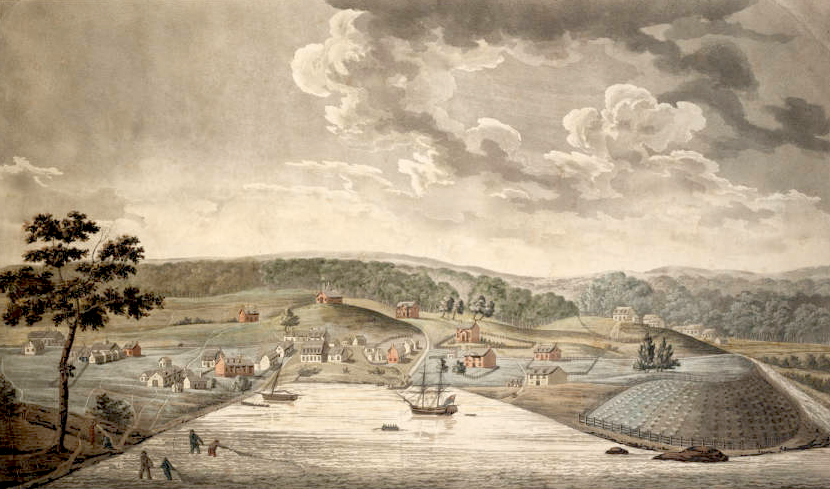

Baltimore Town in 1752
The colonial General Assembly of Maryland created the Port of Baltimore at old Whetstone Point (now Locust Point) in 1706 for the tobacco trade. The Town of Baltimore, on the west side of the Jones Falls, was founded and laid out on July 30, 1729. By 1752 the town had just 27 homes, including a church and two taverns.[34] Jonestown and Fells Point had been settled to the east. The three settlements, covering Template:Convert/acresTemplate:Convert/test/Aout, became a commercial hub, and in 1768 were designated as the county seat.[39]
The first printing press was introduced to the city in 1765 by Nicholas Hasselbach, whose equipment was later used in the printing of Baltimore's first newspapers, The Maryland Journal and The Baltimore Advertiser, first published by William Goddard in 1773.[40][41][42]
Baltimore grew swiftly in the 18th century, its plantations producing grain and tobacco for sugar-producing colonies in the Caribbean. The profit from sugar encouraged the cultivation of cane in the Caribbean and the importation of food by planters there.[43] Since Baltimore was the county seat, a courthouse was built in 1768 to serve both the city and county. Its square was a center of community meetings and discussions.
Baltimore established its public market system in 1763.[44] Lexington Market, founded in 1782, is known as one of the oldest continuously operating public markets in the United States today.[45] Lexington Market was also a center of slave trading. Enslaved Black people were sold at numerous sites through the downtown area, with sales advertised in The Baltimore Sun.[46] Both tobacco and sugar cane were labor-intensive crops.
In 1774, Baltimore established the first post office system in what became the United States,[47] and the first water company chartered in the newly independent nation (Baltimore Water Company, 1792).[48][49]
Baltimore played a part in the American Revolution. City leaders such as Jonathan Plowman Jr. led many residents to resist British taxes, and merchants signed agreements refusing to trade with Britain.[50] The Second Continental Congress met in the Henry Fite House from December 1776 to February 1777, effectively making the city the capital of the United States during this period.[51]
The towns of Baltimore, Jonestown, and Fells Point were incorporated as the City of Baltimore in 1796–1797.
19th century
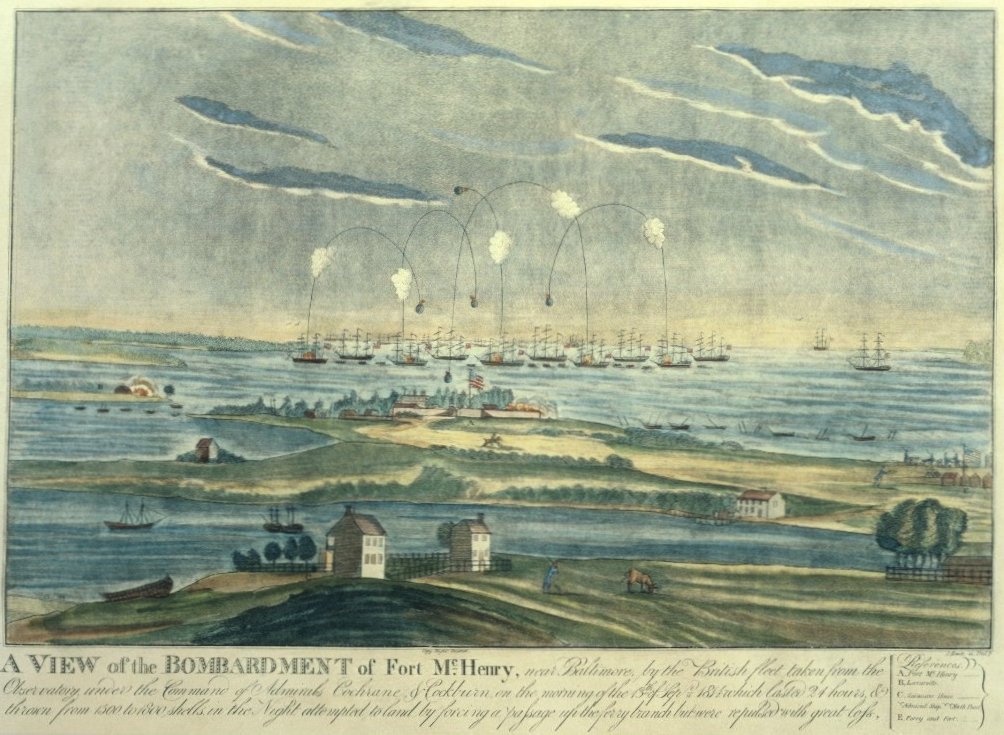

Bombardment of Fort McHenry by the British in 1814[52]


The Battle Monument is the official emblem of Baltimore


Sixth Regiment fighting railroad strikers, July 20, 1877[53]
The city remained a part of surrounding Baltimore County and continued to serve as its county seat from 1768 to 1851, after which it became an independent city.[54]
The Battle of Baltimore against the British in 1814 inspired the U.S. national anthem, "The Star-Spangled Banner", and the construction of the Battle Monument, which became the city's official emblem. A distinctive local culture started to take shape, and a unique skyline peppered with churches and monuments developed. Baltimore acquired its moniker "The Monumental City" after an 1827 visit to Baltimore by President John Quincy Adams. At an evening function, Adams gave the following toast: "Baltimore: the Monumental City—May the days of her safety be as prosperous and happy, as the days of her dangers have been trying and triumphant."[55][56]
Baltimore pioneered the use of gas lighting in 1816, and its population grew rapidly in the following decades, with concomitant development of culture and infrastructure. The construction of the federally funded National Road (which later became part of U.S. Route 40) and the private Baltimore and Ohio Railroad (B. & O.) made Baltimore a major shipping and manufacturing center by linking the city with major markets in the Midwest. By 1820 its population had reached 60,000, and its economy had shifted from its base in tobacco plantations to sawmilling, shipbuilding, and textile production. These industries benefited from war but successfully shifted into infrastructure development during peacetime.[57]
Baltimore had one of the worst riots of the antebellum South in 1835, when bad investments led to the Baltimore bank riot.[58] It was these riots that led to the city being nicknamed "Mobtown".[59] Soon after the city created the world's first dental college, the Baltimore College of Dental Surgery, in 1840, and shared in the world's first telegraph line, between Baltimore and Washington, DC, in 1844.
Maryland, a slave state with limited popular support for secession, especially in the three counties of Southern Maryland, remained part of the Union during the American Civil War, following the 55-12 vote by the Maryland General Assembly against secession. Later, the Union's strategic occupation of the city in 1861 ensured Maryland would not further consider secession.[60][61] The Union's capital, Washington, D.C., then in the state of Maryland, was well-situated to impede Baltimore and Maryland's communication or commerce with the Confederacy. Baltimore saw the first casualties of the war on April 19, 1861, when Union soldiers en route from the President Street Station to Camden Yards clashed with a secessionist mob in the Pratt Street riot.
In the midst of the Long Depression that followed the Panic of 1873, the Baltimore and Ohio Railroad company attempted to lower its workers' wages, leading to strikes and riots in the city and beyond. Strikers clashed with the National Guard, leaving 10 dead and 25 wounded.[62] The beginnings of settlement movement work in Baltimore were made early in 1893, when Rev. Dr. Edward A. Lawrence took up lodgings with his friend Frank Thompson, in one of the Winans tenements, the Lawrence House being established shortly thereafter at 814-816 West Lombard Street.[63][64]
20th century


The Great Baltimore Fire of 1904 as seen from Pratt and Gay Streets
On February 7, 1904, the Great Baltimore Fire destroyed over 1,500 buildings in 30 hours, leaving more than 70 blocks of the downtown area burned to the ground. Damages were estimated at $150 million in 1904 dollars.[65] As the city rebuilt during the next two years, lessons learned from the fire led to improvements in firefighting equipment standards.[66]
Baltimore lawyer Milton Dashiell advocated for an ordinance to bar African-Americans from moving into the Eutaw Place neighborhood in northwest Baltimore. He proposed to recognize majority white residential blocks and majority black residential blocks and to prevent people from moving into housing on such blocks where they would be a minority. The Baltimore Council passed the ordinance, and it became law on December 20, 1910, with Democratic Mayor J. Barry Mahool's signature.[67] The Baltimore segregation ordinance was the first of its kind in the United States. Many other southern cities followed with their own segregation ordinances, though the US Supreme Court ruled against them in Buchanan v. Warley (1917).[68]
The city grew in area by annexing new suburbs from the surrounding counties through 1918, when the city acquired portions of Baltimore County and Anne Arundel County.[69] A state constitutional amendment, approved in 1948, required a special vote of the citizens in any proposed annexation area, effectively preventing any future expansion of the city's boundaries.[70] Streetcars enabled the development of distant neighborhoods areas such as Edmonson Village whose residents could easily commute to work downtown.[71]
Driven by migration from the deep South and by white suburbanization, the relative size of the city's black population grew from 23.8% in 1950 to 46.4% in 1970.[72] Encouraged by real estate blockbusting techniques, recently settled white areas rapidly became all-black neighborhoods, in a rapid process which was nearly total by 1970.[73]
The Baltimore riot of 1968, coinciding with uprisings in other cities, followed the assassination of Martin Luther King Jr. on April 4, 1968. Public order was not restored until April 12, 1968. The Baltimore uprising cost the city an estimated $10 million (US$ Template:Inflation million in 2026). A total of 12,000 Maryland National Guard and federal troops were ordered into the city.[74] The city experienced challenges again in 1974 when teachers, municipal workers, and police officers conducted strikes.[75]
By the beginning of the 1970s, Baltimore's downtown area, known as the Inner Harbor, had been neglected and was occupied by a collection of abandoned warehouses. The nickname "Charm City" came from a 1975 meeting of advertisers seeking to improve the city's reputation.[76][77] Efforts to redevelop the area started with the construction of the Maryland Science Center, which opened in 1976, the Baltimore World Trade Center (1977), and the Baltimore Convention Center (1979). Harborplace, an urban retail and restaurant complex, opened on the waterfront in 1980, followed by the National Aquarium, Maryland's largest tourist destination, and the Baltimore Museum of Industry in 1981. In 1995, the city opened the American Visionary Art Museum on Federal Hill. During the epidemic of HIV/AIDS in the United States, Baltimore City Health Department official Robert Mehl persuaded the city's mayor to form a committee to address food problems; the Baltimore-based charity Moveable Feast grew out of this initiative in 1990.[78][79][80]
Baltimore has had a high homicide rate for several decades, peaking in 1993, and again in 2015.[81][82] These deaths have taken an especially severe toll within the black community.[83] Following the death of Freddie Gray in April 2015, the city experienced major protests and international media attention, as well as a clash between local youth and police that resulted in a state of emergency declaration and a curfew.[84]
21st century
In 1992, the Baltimore Orioles baseball team moved from Memorial Stadium to Oriole Park at Camden Yards, located downtown near the harbor. Pope John Paul II held an open-air mass at Camden Yards during his papal visit to the United States in October 1995. Three years later the Baltimore Ravens football team moved into M&T Bank Stadium next to Camden Yards.[85] By 2010, the organization's region of service had expanded from merely Baltimore to include all of the Eastern Shore of Maryland.[86]
Baltimore has seen the reopening of the Hippodrome Theatre in 2004,[87] the opening of the Reginald F. Lewis Museum of Maryland African American History & Culture in 2005, and the establishment of the National Slavic Museum in 2012. On April 12, 2012, Johns Hopkins held a dedication ceremony to mark the completion of one of the United States' largest medical complexes – the Johns Hopkins Hospital in Baltimore – which features the Sheikh Zayed Cardiovascular and Critical Care Tower and The Charlotte R. Bloomberg Children's Center. The event, held at the entrance to the $1.1 billion 1.6 million-square-foot-facility, honored the many donors including Sheikh Khalifa bin Zayed Al Nahyan, first president of the United Arab Emirates, and Michael Bloomberg.[88][89]
On September 19, 2016, the Baltimore City Council approved a $660 million bond deal for the $5.5 billion Port Covington redevelopment project championed by Under Armour founder Kevin Plank and his real estate company Sagamore Development. Port Covington surpassed the Harbor Point development as the largest tax-increment financing deal in Baltimore's history and among the largest urban redevelopment projects in the country.[90] The waterfront development that includes the new headquarters for Under Armour, as well as shops, housing, offices, and manufacturing spaces is projected to create 26,500 permanent jobs with a $4.3 billion annual economic impact.[91] Goldman Sachs invested $233 million into the redevelopment project.[92]
Geography
Baltimore is in north-central Maryland on the Patapsco River close to where it empties into the Chesapeake Bay. The city is also located on the fall line between the Piedmont Plateau and the Atlantic coastal plain, which divides Baltimore into "lower city" and "upper city". The city's elevation ranges from sea level at the harbor to 480 feet (150 m) in the northwest corner near Pimlico.[6]
According to the 2010 Census, the city has a total area of Template:Convert/sqmi, of which Template:Convert/sqmiTemplate:Convert/test/Aon is land and Template:Convert/sqmiTemplate:Convert/test/Aon is water.[93] The total area is 12.1 percent water.
Baltimore is almost surrounded by Baltimore County, but is politically independent of it. It is bordered by Anne Arundel County to the south.
Cityscape
Script error: No such module "wide image".
Architecture
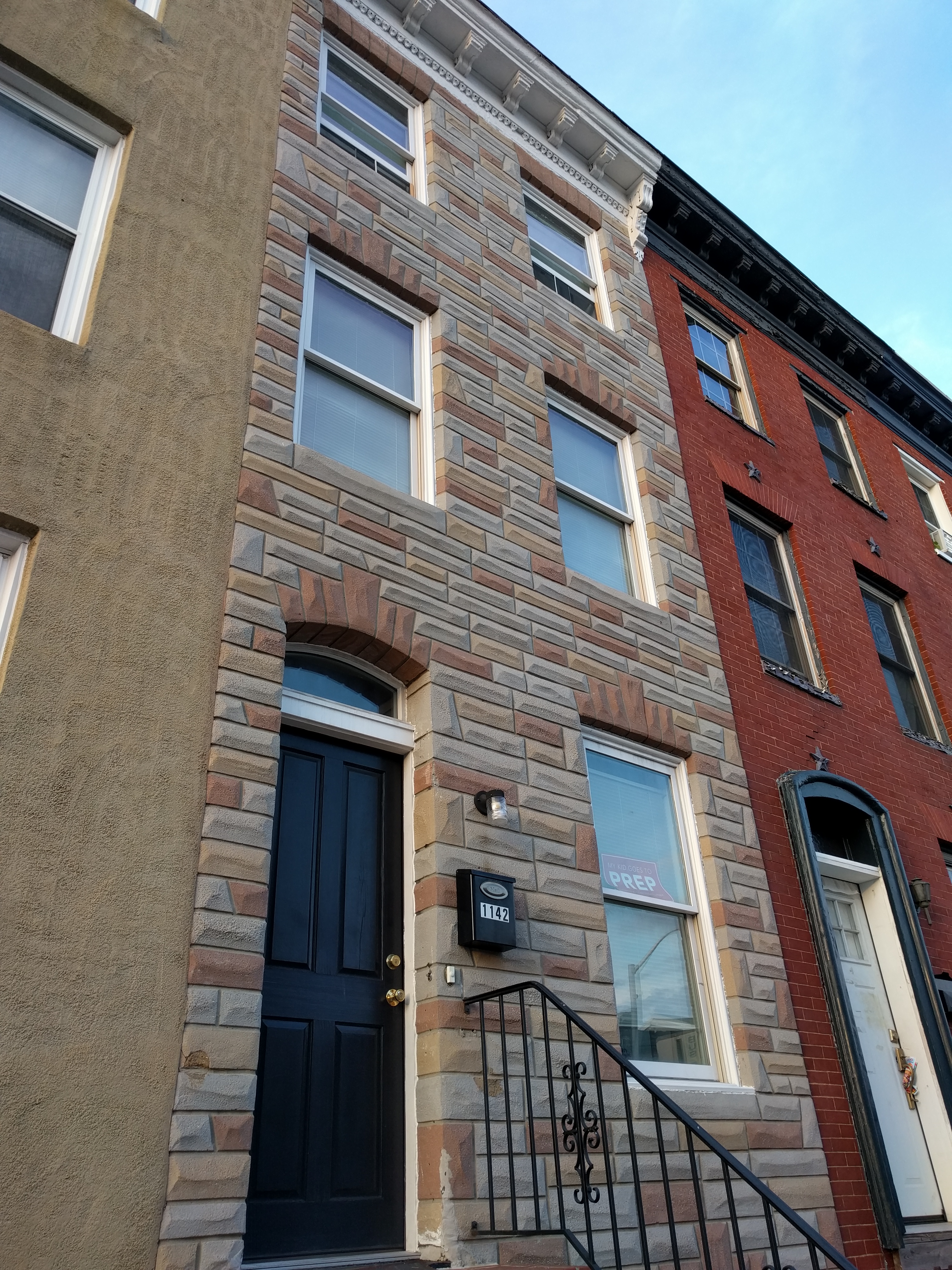

A British-style rowhouse with formstone in West Baltimore
Baltimore exhibits examples from each period of architecture over more than two centuries, and work from architects such as Benjamin Latrobe, George A. Frederick, John Russell Pope, Mies van der Rohe and I. M. Pei.
The city is rich in architecturally significant buildings in a variety of styles. The Baltimore Basilica (1806–1821) is a neoclassical design by Benjamin Latrobe, and one of the oldest Catholic cathedrals in the United States. In 1813 Robert Cary Long Sr. built for Rembrandt Peale the first substantial structure in the United States designed expressly as a museum. Restored, it is now the Municipal Museum of Baltimore, or popularly the Peale Museum.
The McKim Free School was founded and endowed by John McKim. However, the building was erected by his son Isaac in 1822 after a design by William Howard and William Small. It reflects the popular interest in Greece when the nation was securing its independence and a scholarly interest in recently published drawings of Athenian antiquities.
The Phoenix Shot Tower (1828), at 234.25 feet (71.40 m) tall, was the tallest building in the United States until the time of the Civil War, and is one of few remaining structures of its kind.[94] It was constructed without the use of exterior scaffolding. The Sun Iron Building, designed by R.C. Hatfield in 1851, was the city's first iron-front building and was a model for a whole generation of downtown buildings. Brown Memorial Presbyterian Church, built in 1870 in memory of financier George Brown, has stained glass windows by Louis Comfort Tiffany and has been called "one of the most significant buildings in this city, a treasure of art and architecture" by Baltimore magazine.[95][96]
The 1845 Greek Revival-style Lloyd Street Synagogue is one of the oldest synagogues in the United States. The Johns Hopkins Hospital, designed by Lt. Col. John S. Billings in 1876, was a considerable achievement for its day in functional arrangement and fireproofing.
I.M. Pei's World Trade Center (1977) is the tallest equilateral pentagonal building in the world at 405 feet (123 m) tall.
The Harbor East area has seen the addition of two new towers which have completed construction: a 24-floor tower that is the new world headquarters of Legg Mason, and a 21-floor Four Seasons Hotel complex.
The streets of Baltimore are organized in a grid and spoke pattern, lined with tens of thousands of rowhouses. The mix of materials on the face of these rowhouses also give Baltimore its distinct look. The rowhouses are a mix of brick and formstone facings, a technology patented in 1937 by Albert Knight. John Waters characterized formstone as "the polyester of brick" in a 30-minute documentary film, Little Castles: A Formstone Phenomenon.[97] In The Baltimore Rowhouse, Mary Ellen Hayward and Charles Belfoure considered the rowhouse as the architectural form defining Baltimore as "perhaps no other American city".[98] In the mid-1790s, developers began building entire neighborhoods of the British-style rowhouses, which became the dominant house type of the city early in the 19th century.[99]
Oriole Park at Camden Yards is a Major League Baseball park, opened in 1992, which was built as a retro style baseball park. Camden Yards, along with the National Aquarium, have helped revive the Inner Harbor from what once was an industrial district full of dilapidated warehouses into a bustling commercial district full of bars, restaurants and retail establishments.
After an international competition, the University of Baltimore School of Law awarded the German firm Behnisch Architekten 1st prize for its design, which was selected for the school's new home. After the building's opening in 2013, the design won additional honors including an ENR National "Best of the Best" Award.[100]
Baltimore's newly rehabilitated Everyman Theatre was honored by the Baltimore Heritage at the 2013 Preservation Awards Celebration in 2013. Everyman Theatre will receive an Adaptive Reuse and Compatible Design Award as part of Baltimore Heritage's 2013 historic preservation awards ceremony. Baltimore Heritage is Baltimore's nonprofit historic and architectural preservation organization, which works to preserve and promote Baltimore's historic buildings and neighborhoods.[101]
Tallest buildings
| Rank | Building | Height | Floors | Built | |
|---|---|---|---|---|---|
| 1 | Transamerica Tower (formerly the Legg Mason Building, originally built as the U.S. Fidelity and Guarantee Co. Building)[102] | 529 feet (Template:Convert/pround m) | 40 | 1973 | [103] |
| 2 | Bank of America Building (originally built as Baltimore Trust Building, later Sullivan, Mathieson, Md. Nat. Bank, NationsBank Bldgs.) | 509 feet (Template:Convert/pround m) | 37 | 1929 | [104] |
| 3 | 414 Light Street | 500 feet (Template:Convert/pround m) | 44 | 2018 | [105] |
| 4 | William Donald Schaefer Tower (originally built as the Merritt S. & L. Tower) | 493 feet (Template:Convert/pround m) | 37 | 1992 | [106] |
| 5 | Commerce Place (Alex. Brown & Sons/Deutsche Bank Tower) | 454 feet (Template:Convert/pround m) | 31 | 1992 | [107] |
| 6 | Baltimore Marriott Waterfront Hotel | 430 feet (Template:Convert/pround m) | 32 | 2001 | [108] |
| 7 | 100 East Pratt Street (originally built as the I.B.M. Building) | 418 feet (Template:Convert/pround m) | 28 | 1975/1992 | [109] |
| 8 | Baltimore World Trade Center | 405 feet (Template:Convert/pround m) | 28 | 1977 | [110] |
| 9 | Tremont Plaza Hotel | 395 feet (Template:Convert/pround m) | 37 | 1967 | [111] |
| 10 | Charles Towers South | 385 feet (Template:Convert/pround m) | 30 | 1969 | [112] |
Neighborhoods
Script error: No such module "Labelled list hatnote".
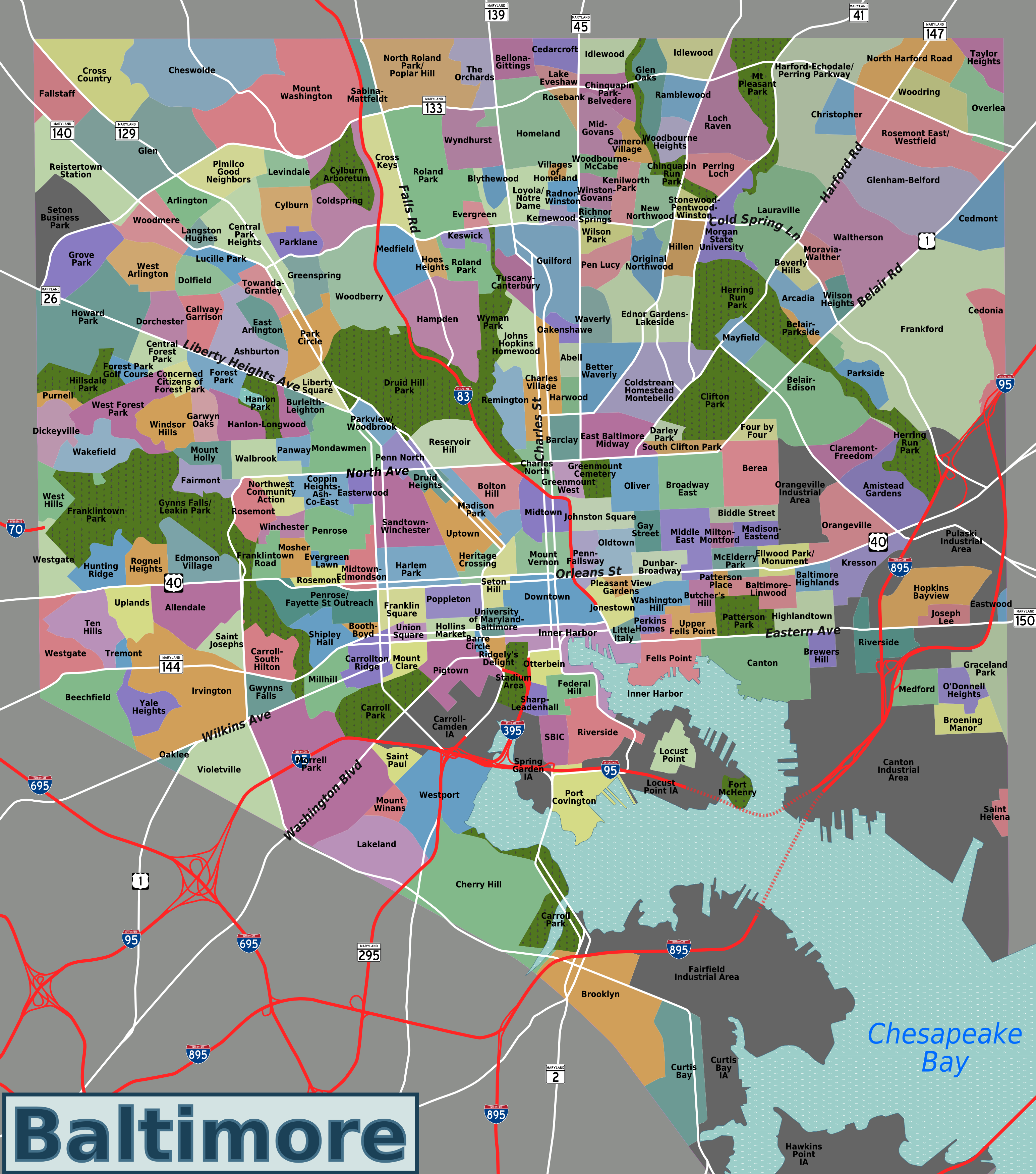

A map of Baltimore's city-designated neighborhoods
Baltimore is officially divided into nine geographical regions: North, Northeast, East, Southeast, South, Southwest, West, Northwest, and Central, with each district patrolled by a respective Baltimore Police Department. Interstate 83 and Charles Street down to Hanover Street and Ritchie Highway serve as the east–west dividing line and Eastern Avenue to Route 40 as the north–south dividing line; however, Baltimore Street is north–south dividing line for the U.S. Postal Service.[113]
Central Baltimore
Central Baltimore, originally called the Middle District,[114] stretches north of the Inner Harbor up to the edge of Druid Hill Park. Downtown Baltimore has mainly served as a commercial district with limited residential opportunities; however, between 2000 and 2010, the downtown population grew 130 percent as old commercial properties have been replaced by residential property.[115] Still the city's main commercial area and business district, it includes Baltimore's sports complexes: Oriole Park at Camden Yards, M&T Bank Stadium, and the Royal Farms Arena; and the shops and attractions in the Inner Harbor: Harborplace, the Baltimore Convention Center, the National Aquarium, Maryland Science Center, Pier Six Pavilion, and Power Plant Live.[113]
The University of Maryland, Baltimore, the University of Maryland Medical Center, and Lexington Market are also in the central district, as well as the Hippodrome and many nightclubs, bars, restaurants, shopping centers and various other attractions.[113][114] The northern portion of Central Baltimore, between downtown and the Druid Hill Park, is home to many of the city's cultural opportunities. Maryland Institute College of Art, the Peabody Institute (music conservatory), George Peabody Library, Enoch Pratt Free Library – Central Library, the Lyric Opera House, the Joseph Meyerhoff Symphony Hall, the Walters Art Museum, the Maryland Center for History and Culture and its Enoch Pratt Mansion, and several galleries are located in this region.[116]
North Baltimore


Sherwood Gardens neighborhood
Several historic and notable neighborhoods are in this district: Govans (1755), Roland Park (1891), Guilford (1913), Homeland (1924), Hampden, Woodberry, Old Goucher (the original campus of Goucher College), and Jones Falls. Along the York Road corridor going north are the large neighborhoods of Charles Village, Waverly, and Mount Washington. The Station North Arts and Entertainment District is also located in North Baltimore.[117]
South Baltimore


Rowhouses in the Federal Hill neighborhood
South Baltimore, a mixed industrial and residential area, consists of the "Old South Baltimore" peninsula below the Inner Harbor and east of the old B&O Railroad's Camden line tracks and Russell Street downtown. It is a culturally, ethnically, and socioeconomically diverse waterfront area with neighborhoods such as Locust Point and Riverside around a large park of the same name.[118] Just south of the Inner Harbor, the historic Federal Hill neighborhood, is home to many working professionals, pubs and restaurants. At the end of the peninsula is historic Fort McHenry, a National Park since the end of World War I, when the old U.S. Army Hospital surrounding the 1798 star-shaped battlements was torn down.[119]
Across the Hanover Street Bridge are residential areas such as Cherry Hill.[120]
Northeast Baltimore
Northeast is primarily a residential neighborhood, home to Morgan State University, bounded by the city line of 1919 on its northern and eastern boundaries, Sinclair Lane, Erdman Avenue, and Pulaski Highway to the south and The Alameda on to the west. Also in this wedge of the city on 33rd Street is Baltimore City College high school, third oldest active public secondary school in the United States, founded downtown in 1839.[121] Across Loch Raven Boulevard is the former site of the old Memorial Stadium home of the Baltimore Colts, Baltimore Orioles, and Baltimore Ravens, now replaced by a YMCA athletic and housing complex.[122][123] Lake Montebello is in Northeast Baltimore.[114]
East Baltimore
Located below Sinclair Lane and Erdman Avenue, above Orleans Street, East Baltimore is mainly made up of residential neighborhoods. This section of East Baltimore is home to Johns Hopkins Hospital, Johns Hopkins University School of Medicine, and Johns Hopkins Children's Center on Broadway. Notable neighborhoods include: Armistead Gardens, Broadway East, Barclay, Ellwood Park, Greenmount, and McElderry Park.[114]
This area was the on-site film location for Homicide: Life on the Street, The Corner and The Wire.[124]
Southeast Baltimore
Southeast Baltimore, located below Fayette Street, bordering the Inner Harbor and the Northwest Branch of the Patapsco River to the west, the city line of 1919 on its eastern boundaries and the Patapsco River to the south, is a mixed industrial and residential area. Patterson Park, the "Best Backyard in Baltimore",[125] as well as the Highlandtown Arts District, and Johns Hopkins Bayview Medical Center are located in Southeast Baltimore. The Shops at Canton Crossing opened in 2013.[126] The Canton neighborhood, is located along Baltimore's prime waterfront. Other historic neighborhoods include: Fells Point, Patterson Park, Butchers Hill, Highlandtown, Greektown, Harbor East, Little Italy, and Upper Fell's Point.[114]
Northwest Baltimore
Northwestern is bounded by the county line to the north and west, Gwynns Falls Parkway on the south and Pimlico Road on the east, is home to Pimlico Race Course, Sinai Hospital, and the headquarters of the NAACP. Its neighborhoods are mostly residential and are dissected by Northern Parkway. The area has been the center of Baltimore's Jewish community since after World War II. Notable neighborhoods include: Pimlico, Mount Washington, and Cheswolde, and Park Heights.[127]
West Baltimore
West Baltimore is west of downtown and the Martin Luther King Jr. Boulevard and is bounded by Gwynns Falls Parkway, Fremont Avenue, and West Baltimore Street. The Old West Baltimore Historic District includes the neighborhoods of Harlem Park, Sandtown-Winchester, Druid Heights, Madison Park, and Upton.[128][129] Originally a predominantly German neighborhood, by the last half of the 19th century, Old West Baltimore was home to a substantial section of the city's Black population.[128]
It became the largest neighborhood for the city's Black community and its cultural, political, and economic center.[128] Coppin State University, Mondawmin Mall, and Edmondson Village are located in this district. The area's crime problems have provided subject material for television series, such as The Wire.[130] Local organizations, such as the Sandtown Habitat for Humanity and the Upton Planning Committee, have been steadily transforming parts of formerly blighted areas of West Baltimore into clean, safe communities.[131][132]
Southwest Baltimore
Southwest Baltimore is bound by the Baltimore County line to the west, West Baltimore Street to the north, and Martin Luther King Jr. Boulevard and Russell Street/Baltimore-Washington Parkway (Maryland Route 295) to the east. Notable neighborhoods in Southwest Baltimore include: Pigtown, Carrollton Ridge, Ridgely's Delight, Leakin Park, Violetville, Lakeland, and Morrell Park.[114]
St. Agnes Hospital on Wilkens and Caton[114] avenues is located in this district with the neighboring Cardinal Gibbons High School, which is the former site of Babe Ruth's alma mater, St. Mary's Industrial School.[Citation needed] Through this segment of Baltimore ran the beginnings of the historic National Road, which was constructed beginning in 1806 along Old Frederick Road and continuing into the county on Frederick Road into Ellicott City, Maryland.[Citation needed] Other sides in this district are: Carroll Park, one of the city's largest parks, the colonial Mount Clare Mansion, and Washington Boulevard, which dates to pre-Revolutionary War days as the prime route out of the city to Alexandria, Virginia, and Georgetown on the Potomac River.[Citation needed]


Adjacent communities
The City of Baltimore is bordered by the following communities, all unincorporated census-designated places.
Climate
Baltimore has a humid subtropical climate (Cfa) in the Köppen climate classification, with long, hot summers, cool winters, and a summer peak to annual precipitation.[133][134] Baltimore is part of USDA plant hardiness zones 7b and 8a.[135] Summers are normally warm, with occasional late day thunderstorms. July, the warmest month, has a mean temperature of Template:Convert/°F. Winters range from chilly to mild but vary, with sporadic snowfall: January has a daily average of Template:Convert/°F,[136] though temperatures reach Template:Convert/°F quite often, and can occasionally drop below Template:Convert/°F when Arctic air masses affect the area.[136]
Spring and autumn are mild, with spring being the wettest season in terms of the number of precipitation days. Summers are hot and humid with a daily average in July of Template:Convert/°F.[136] The combination of heat and humidity leads to occasional thunderstorms. A southeasterly bay breeze off the Chesapeake often occurs on summer afternoons when hot air rises over inland areas. Prevailing winds from the southwest interacting with this breeze as well as the city proper's UHI can seriously exacerbate air quality.[137][138] In late summer and early autumn the track of hurricanes or their remnants may cause flooding in downtown Baltimore, despite the city being far removed from the typical coastal storm surge areas.[139]
The average seasonal snowfall is Template:Convert/in.[140] It varies greatly by year, with some seasons seeing only trace accumulations of snow, while others see several major Nor'easters.[lower-alpha 2] Owing to lessened urban heat island (UHI) as compared to the city proper and distance from the moderating Chesapeake Bay, the outlying and inland parts of the Baltimore metro area are usually cooler, especially at night, than the city proper and the coastal towns. Thus, in the northern and western suburbs, winter snowfall is more significant, and some areas average more than Template:Convert/inTemplate:Convert/test/Aon of snow per winter.[142]
It is by no means uncommon for the rain-snow line to set up in the metro area.[143] Freezing rain and sleet occur a few times some winters in the area, as warm air overrides cold air at the low to mid-levels of the atmosphere. When the wind blows from the east, the cold air gets dammed against the mountains to the west and the result is freezing rain or sleet.
Like all of Maryland, Baltimore is at risk for increased impacts of climate change. Historically, flooding has ruined houses and almost killed people, especially in lower income majority Black neighborhoods, and caused sewage backups, given the existing disrepair of Baltimore's water system.[144]
Extreme temperatures range from Template:Convert/°F on February 9, 1934, and February 10, 1899,[lower-alpha 3] up to Template:Convert/°F on July 22, 2011.[145][146] On average, temperatures of Template:Convert/°F or more occur on three days annually, Template:Convert/°F or more on 43 days, and there are nine days where the high fails to reach the freezing mark.[136]
Script error: No such module "weather box". Script error: No such module "weather box".
| Climate data for Baltimore | |||||||||||||
|---|---|---|---|---|---|---|---|---|---|---|---|---|---|
| Month | Jan | Feb | Mar | Apr | May | Jun | Jul | Aug | Sep | Oct | Nov | Dec | Year |
| Average sea temperature °F (°C) | 46.0 (7.8) |
44.4 (6.9) |
45.1 (7.3) |
50.4 (10.2) |
55.9 (13.3) |
68.2 (20.1) |
75.6 (24.2) |
77.4 (25.2) |
73.4 (23.0) |
66.0 (18.9) |
57.2 (14.0) |
50.7 (10.4) |
59.2 (15.1) |
| Mean daily daylight hours | 10.0 | 11.0 | 12.0 | 13.0 | 14.0 | 15.0 | 15.0 | 14.0 | 12.0 | 11.0 | 10.0 | 9.0 | 12.2 |
| Source: Weather Atlas[149] | |||||||||||||
Demographics
Population
Template:Historical population
In 2011, then-Mayor Stephanie Rawlings-Blake said her main goal was to increase the city's population by improving city services to reduce the number of people leaving the city and by passing legislation protecting immigrants' rights to stimulate growth.[150] Baltimore is sometimes identified as a sanctuary city.[151] In 2019, then-Mayor Jack Young said that Baltimore will not assist ICE agents with immigration raids.[152]
Baltimore City's population has declined overall from 2010 to 2020 by about 34,830 people, representing a 5.6% drop. The official US census places the city's population at 585,708 for 2020. The year between 2018 and 2019 had the largest year-to-year population loss, and in 2020 Baltimore lost more population than any other major city in the United States.[153][7][154]
Gentrification has increased since the 2000 census, primarily in East Baltimore, downtown, and Central Baltimore, with 14.8% of census tracts having had income growth and home values appreciation at a rate higher than the city overall. Most, but not all, gentrifying neighborhoods are predominantly white areas which have seen a turnover from lower income to higher income households. These areas represent either expansion of existing gentrified areas, or activity around the Inner Harbor, downtown, or the Johns Hopkins Homewood campus.[155] In some neighborhoods in East Baltimore, the Hispanic population has increased along with home values and income, while both the non-Hispanic white and non-Hispanic black populations have declined, a trend which is not seen in many other American cities.[156]
After New York City, Baltimore was the second city in the United States to reach a population of 100,000.[157][158] From the 1820 through 1850 U.S. censuses, Baltimore was the second most-populous city,[158][159] before being surpassed by Philadelphia in 1860.[160] It was among the top 10 cities in population in the United States in every census up through the 1980 census,[161] and after World War II had a population of nearly 1 million.
Characteristics
.png)
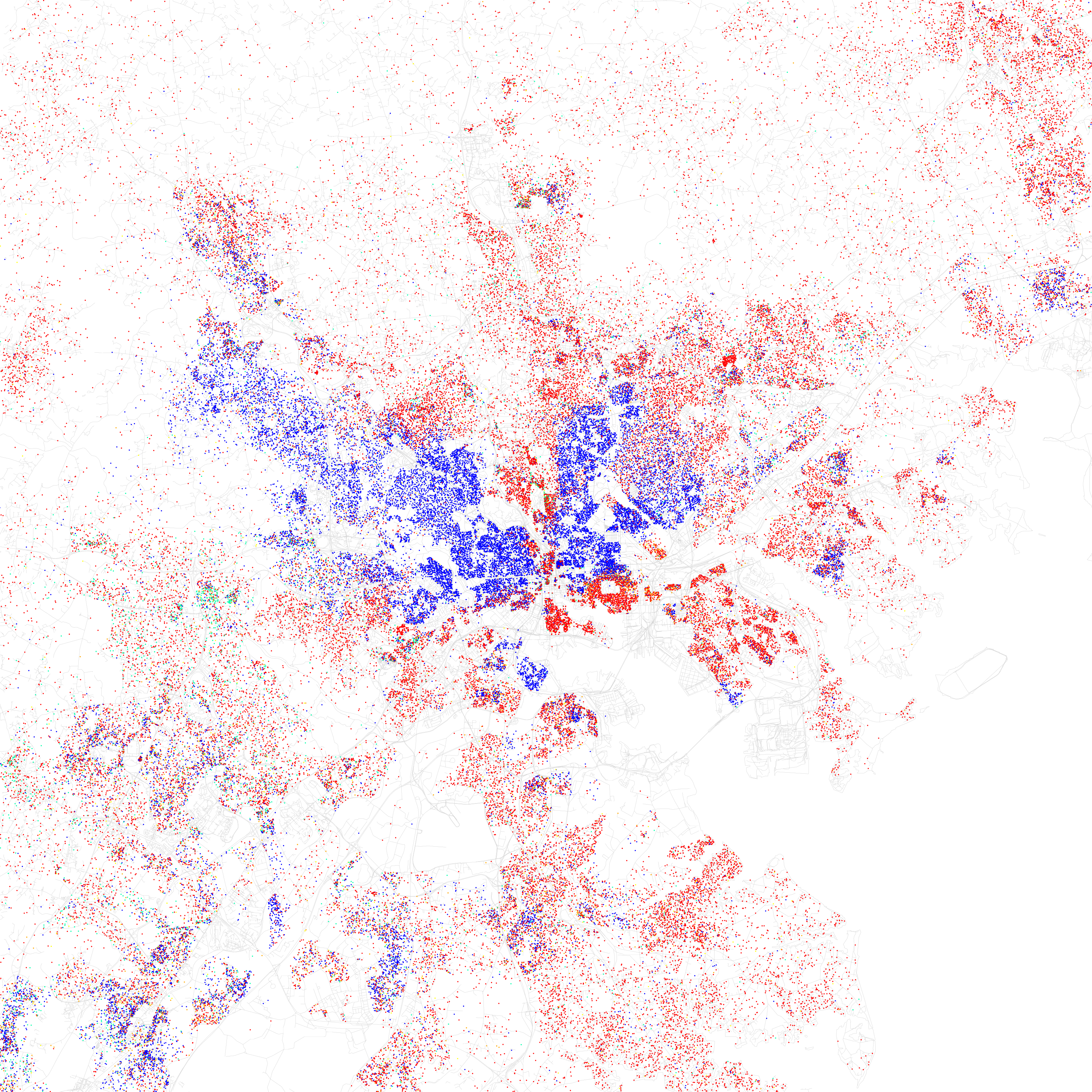
A racial distribution map of Baltimore, 2010 U.S. Census. Each dot is 25 people: Template:Legend inline Template:Legend inline Template:Legend inline Template:Legend inline Template:Legend inline
| Demographic profile | 2020[162] | 2010[163] | 1990[164] | 1970[164] | 1940[164] |
|---|---|---|---|---|---|
| White | 31.9% | 29.6% | 39.1% | 53.0% | 80.6% |
| —Non-Hispanic whites | 27.6% | 28.0% | 38.6% | 52.3%[lower-alpha 4] | 80.6% |
| Black or African American (non-Hispanic) | 62.4% | 63.7% | 59.2% | 46.4% | 19.3% |
| Hispanic or Latino (of any race) | 6.0% | 4.2% | 1.0% | 0.9%[lower-alpha 4] | 0.1% |
| Asian | 2.8% | 2.3% | 1.1% | 0.3% | 0.1% |
In the Template:Asof, Baltimore's population was 63.7% Black, 29.6% White (6.9% German, 5.8% Italian, 4% Irish, 2% American, 2% Polish, 0.5% Greek) 2.3% Asian (0.54% Korean, 0.46% Indian, 0.37% Chinese, 0.36% Filipino, 0.21% Nepali, 0.16% Pakistani), and 0.4% Native American and Alaska Native. Across races, 4.2% of the population are of Hispanic, Latino, or Spanish origin (1.63% Salvadoran, 1.21% Mexican, 0.63% Puerto Rican, 0.6% Honduran).[11]
As per the 2020 Census, 8.1% of residents between 2016 and 2020 were foreign born persons.[162] Females made up 53.4% of the population. The median age was 35 years old, with 22.4% under 18 years old, 65.8% from 18 to 64 years old, and 11.8% 65 or older.[11]
Baltimore has a large Caribbean American population, with the largest groups being Jamaicans and Trinidadians. Baltimore's Jamaican community is largely centered in the Park Heights neighborhood, but generations of immigrants have also lived in Southeast Baltimore.[165]
In 2005, approximately 30,778 people (6.5%) identified as gay, lesbian, or bisexual.[166] In 2012, same-sex marriage in Maryland was legalized, going into effect January 1, 2013.[167]
Income and housing
Between 2016 and 2020, the median household was $52,164 and the median income per capita to $32,699, compared to the national averages of $64,994 and $35,384, respectively.[162] In 2009, the median household income was $42,241 and the median income per capita was $25,707, compared to the national median income of $53,889 per household and $28,930 per capita.[11]
In 2009, 23.7% of the population lived below the poverty line, compared to 13.5% nationwide.[11] In the 2020 Census, 20% of Baltimore residents were living in poverty, compared to 11.6% nationwide.[162]
Housing in Baltimore is relatively inexpensive for large, coastal cities of its size. The median sale price for homes in Baltimore as of December 2022 was $209,000, up from $95,000 in 2012.[168][169] Despite the housing collapse, and along with the national trends, Baltimore residents still faced slowly increasing rent (up 3% in the summer of 2010).[170] The median value of owner-occupied housing units between 2016 and 2020 was $242,499.[162]
The homeless population in Baltimore is steadily increasing; it exceeded 4,000 people in 2011. The increase in the number of young homeless people was particularly severe.[171]
Life expectancy
As of 2015, life expectancy in Baltimore was 74 to 75 years, compared to the U.S. average of 78 to 80. Fourteen neighborhoods had lower life expectancies than North Korea. The life expectancy in Downtown/Seton Hill was comparable to that of Yemen.[172]
Religion
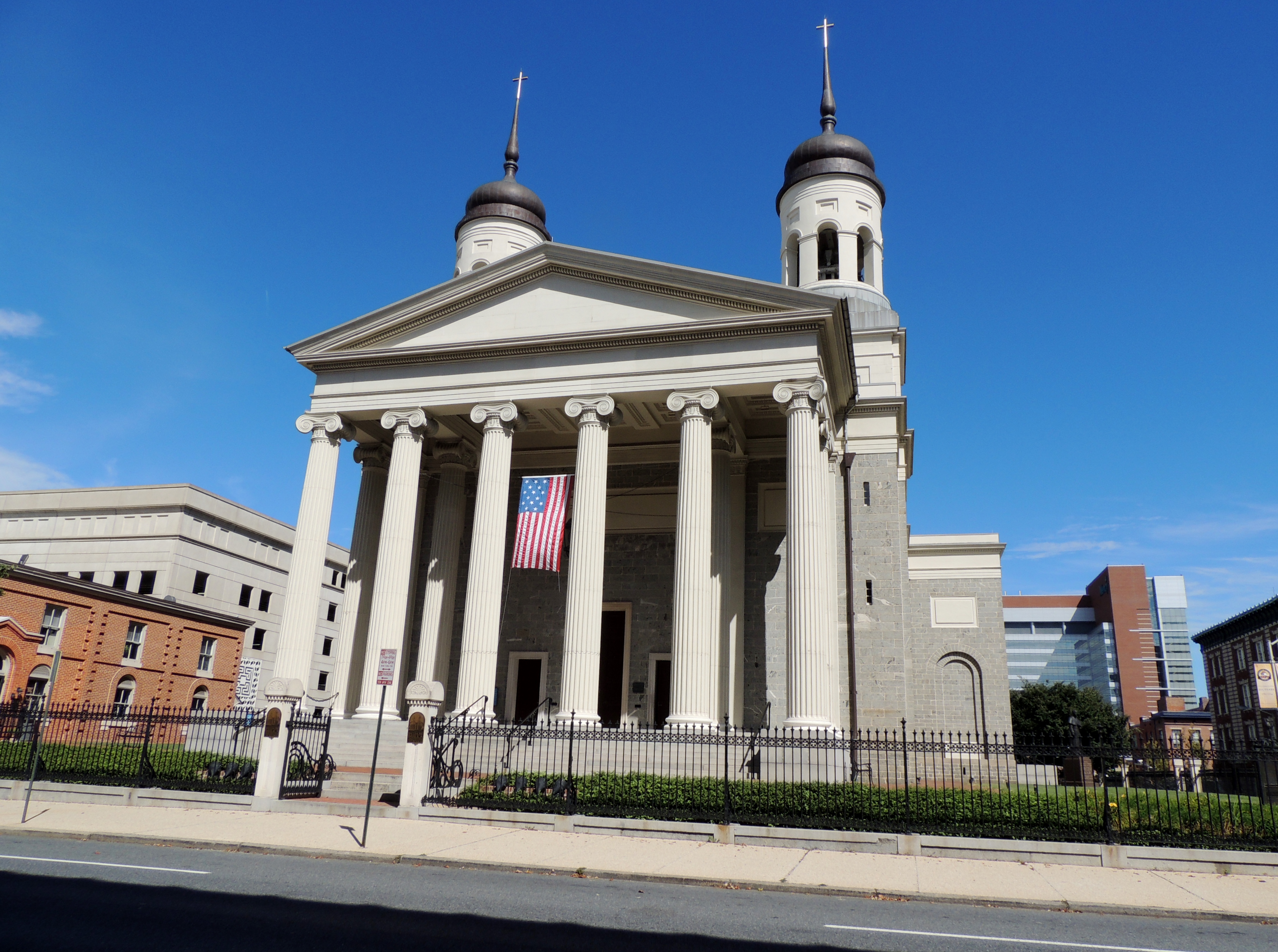

Baltimore Basilica, the first cathedral built in the United States
In 2015, 25% of adults in Baltimore reported affiliation with no religion. 50% of the adult population of Baltimore are Protestants.[lower-alpha 5] Catholicism is the second largest religious affiliation, comprising 15% percent of the population, followed by Judaism (3%) and Islam (2%). Around 1% identify with other Christian denominations.[173][174][175]
Languages
As of 2010[update], 91% (526,705) of Baltimore residents five years old and older spoke only English at home. Close to 4% (21,661) spoke Spanish. Other languages, such as African languages, French, and Chinese are spoken by less than 1% of the population.[176]
Crime

_and_Franklintown_Road_in_Baltimore_City,_Maryland.jpg)
Baltimore Police Department patrol car
Crime in Baltimore, generally concentrated in areas high in poverty, has been extreme for many years. Overall reported crime has dropped by 60% from the mid-1990s to the mid-2010s, but homicide rates remain high and exceed the national average. The worst years for crime in Baltimore overall were from 1993 to 1996; with 96,243 crimes reported in 1995. Baltimore's 344 homicides in 2015 represented the highest homicide rate in the city's recorded history—52.5 per 100,000 people, surpassing the record set in 1993—and the second-highest for U.S. cities behind St. Louis and ahead of Detroit. Of Baltimore's 344 homicides in 2015, 321 (93.3%) of the victims were African-American.[Citation needed]
Drug use and deaths by drug use (particularly drugs used intravenously, such as heroin) are a related problem which has impaired Baltimore for decades. Among cities greater than 400,000, Baltimore ranked 2nd in its opiate drug death rate in the United States behind Dayton, Ohio. The DEA reported that 10% of Baltimore's population – about 64,000 people – are addicted to heroin, most of which is trafficked into the city from New York.[177][178][179][180][181]
In 2011, Baltimore police reported 196 homicides, the lowest number in the city since 197 homicides in 1978 and far lower than the peak homicide count of 353 slayings in 1993. City leaders at the time credited a sustained focus on repeat violent offenders and increased community engagement for the continued drop, reflecting a nationwide decline in crime.[182][183]
On August 8, 2014, Baltimore's new youth curfew law went into effect. It prohibits unaccompanied children under age 14 from being on the streets after 9 p.m. and those aged 14–16 from being out after 10 p.m. during the week and 11 p.m. on weekends and during the summer. The goal is to keep children out of dangerous places and reduce crime.[184]
Crime in Baltimore reached another peak in 2015 when the year's tally of 344 homicides was second only to the record 353 in 1993, when Baltimore had about 100,000 more residents. The killings in 2015 were on pace with recent years in the early months of 2015 but skyrocketed after the unrest and rioting of late April following the killing of Freddie Gray by police. In five of the next eight months, killings topped 30–40 per month. Nearly 90 percent of 2015's homicides resulted from shootings, renewing calls for new gun laws. In 2016, according to annual crime statistics released by the Baltimore Police Department, there were 318 murders in the city.[185] This total marked a 7.56 percent decline in homicides from 2015.
In an interview with The Guardian, on November 2, 2017,[186] David Simon, himself a former police reporter for The Baltimore Sun, ascribed the most recent surge in murders to the high-profile decision by Baltimore state's attorney, Marilyn Mosby, to charge six city police officers following the death of Freddie Gray after he was paralyzed during a "rough-ride" in a police van while in police custody in April 2015, dying from the injury a week later. "What Mosby basically did was send a message to the Baltimore police department: 'I'm going to put you in jail for making a bad arrest.' So officers figured it out: 'I can go to jail for making the wrong arrest, so I'm not getting out of my car to clear a corner,' and that's exactly what happened post-Freddie Gray."[186]
In Baltimore, "arrest numbers have plummeted from more than 40,000 in 2014, the year before Gray's death and the charges against the officers, to about 18,000 [as of November 2017]. This happened as homicides soared from 211 in 2014 to 344 in 2015 – an increase of 63%."[186] Simon's HBO miniseries We Own This City aired in April 2022 and covered many of the events surrounding the death of Freddie Gray and the work slowdown by the Baltimore Police Department during that time period.
In 2022, Baltimore tallied 335 homicides.[187]
Economy
Once a predominantly industrial town, with an economic base focused on steel processing, shipping, auto manufacturing (General Motors Baltimore Assembly), and transportation, the city experienced deindustrialization, which cost residents tens of thousands of low-skill, high-wage jobs.[188] The city now relies on a low-wage service economy, which accounts for 31% of jobs in the city.[189][190] Around the turn of the 20th century, Baltimore was the leading U.S. manufacturer of rye whiskey and straw hats. It also led in refining of crude oil, brought to the city by pipeline from Pennsylvania.[191][192][193]
As of March 2018[update] the U.S. Bureau of Labor Statistics calculated Baltimore's unemployment rate at 5.8%[194] while one quarter of Baltimore residents (and 37% of Baltimore children) live in poverty.[195] The 2012 closure of a major steel plant at Sparrows Point is expected to have a further impact on employment and the local economy.[196] The Census Bureau reported in 2013 that 207,000 workers commute into Baltimore city each day.[197] Downtown Baltimore is the primary economic asset within Baltimore City and the region with 29.1 million square feet of office space. The tech sector is rapidly growing as the Baltimore metro ranks 8th in the CBRE Tech Talent Report among 50 U.S. metro areas for high growth rate and number of tech professionals.[198] Forbes ranked Baltimore fourth among America's "new tech hot spots".[199]
The city is home to the Johns Hopkins Hospital. Other large companies in Baltimore include Under Armour,[200] BRT Laboratories, Cordish Company,[201] Legg Mason, McCormick & Company, T. Rowe Price, and Royal Farms.[202] A sugar refinery owned by American Sugar Refining is one of Baltimore's cultural icons. Nonprofits based in Baltimore include Lutheran Services in America and Catholic Relief Services.
Almost a quarter of the jobs in the Baltimore region were in science, technology, engineering, and math as of mid-2013, a fact attributed in part to the city's extensive undergraduate and graduate schools; maintenance and repair experts were included in this count.[203]
Port
The center of international commerce for the region is the World Trade Center Baltimore. It houses the Maryland Port Administration and U.S. headquarters for major shipping lines. Baltimore is ranked 9th for total dollar value of cargo and 13th for cargo tonnage for all U.S. ports. In 2014, total cargo moving through the port totaled 29.5 million tons, down from 30.3 million tons in 2013. The value of cargo traveling through the port in 2014 came to $52.5 billion, down from $52.6 billion in 2013. The Port of Baltimore generates $3 billion in annual wages and salary, as well as supporting 14,630 direct jobs and 108,000 jobs connected to port work. In 2014, the port also generated more than $300 million in taxes. It serves over 50 ocean carriers making nearly 1,800 annual visits. Among all U.S. ports, Baltimore is first in handling automobiles, light trucks, farm and construction machinery; and imported forest products, aluminum, and sugar. The port is second in coal exports. The Port of Baltimore's cruise industry, which offers year-round trips on several lines supports over 500 jobs and brings in over $90 million to Maryland's economy annually. Growth at the port continues with the Maryland Port Administration plans to turn the southern tip of the former steel mill into a marine terminal, primarily for car and truck shipments, but also for anticipated new business coming to Baltimore after the completion of the Panama Canal expansion project.[204]
Tourism
Baltimore's history and attractions have made it a popular tourist destination. In 2014, the city hosted 24.5 million visitors, who spent $5.2 billion.[205] The Baltimore Visitor Center, which is operated by Visit Baltimore, is located on Light Street in the Inner Harbor. Much of the city's tourism centers around the Inner Harbor, with the National Aquarium being Maryland's top tourist destination. Baltimore Harbor's restoration has made it "a city of boats", with several historic ships and other attractions on display and open to the public. The USS Constellation, the last Civil War-era vessel afloat, is docked at the head of the Inner Harbor; the USS Torsk, a submarine that holds the Navy's record for dives (more than 10,000); and the Coast Guard cutter WHEC-37, the last surviving U.S. warship that was in Pearl Harbor during the Japanese attack on December 7, 1941, and which engaged Japanese Zero aircraft during the battle.[206]
Also docked is the lightship Chesapeake, which for decades marked the entrance to Chesapeake Bay; and the Seven Foot Knoll Lighthouse, the oldest surviving screw-pile lighthouse on Chesapeake Bay, which once marked the mouth of the Patapsco River and the entrance to Baltimore. All of these attractions are owned and maintained by the Historic Ships in Baltimore organization. The Inner Harbor is also the home port of Pride of Baltimore II, the state of Maryland's "goodwill ambassador" ship, a reconstruction of a famous Baltimore Clipper ship.[206]
Other tourist destinations include sporting venues such as Oriole Park at Camden Yards, M&T Bank Stadium, and Pimlico Race Course, Fort McHenry, the Mount Vernon, Federal Hill, and Fells Point neighborhoods, Lexington Market, Horseshoe Casino, and museums such as the Walters Art Museum, the Baltimore Museum of Industry, the Babe Ruth Birthplace and Museum, the Maryland Science Center, and the B&O Railroad Museum.


Culture
Script error: No such module "Labelled list hatnote".
.png)
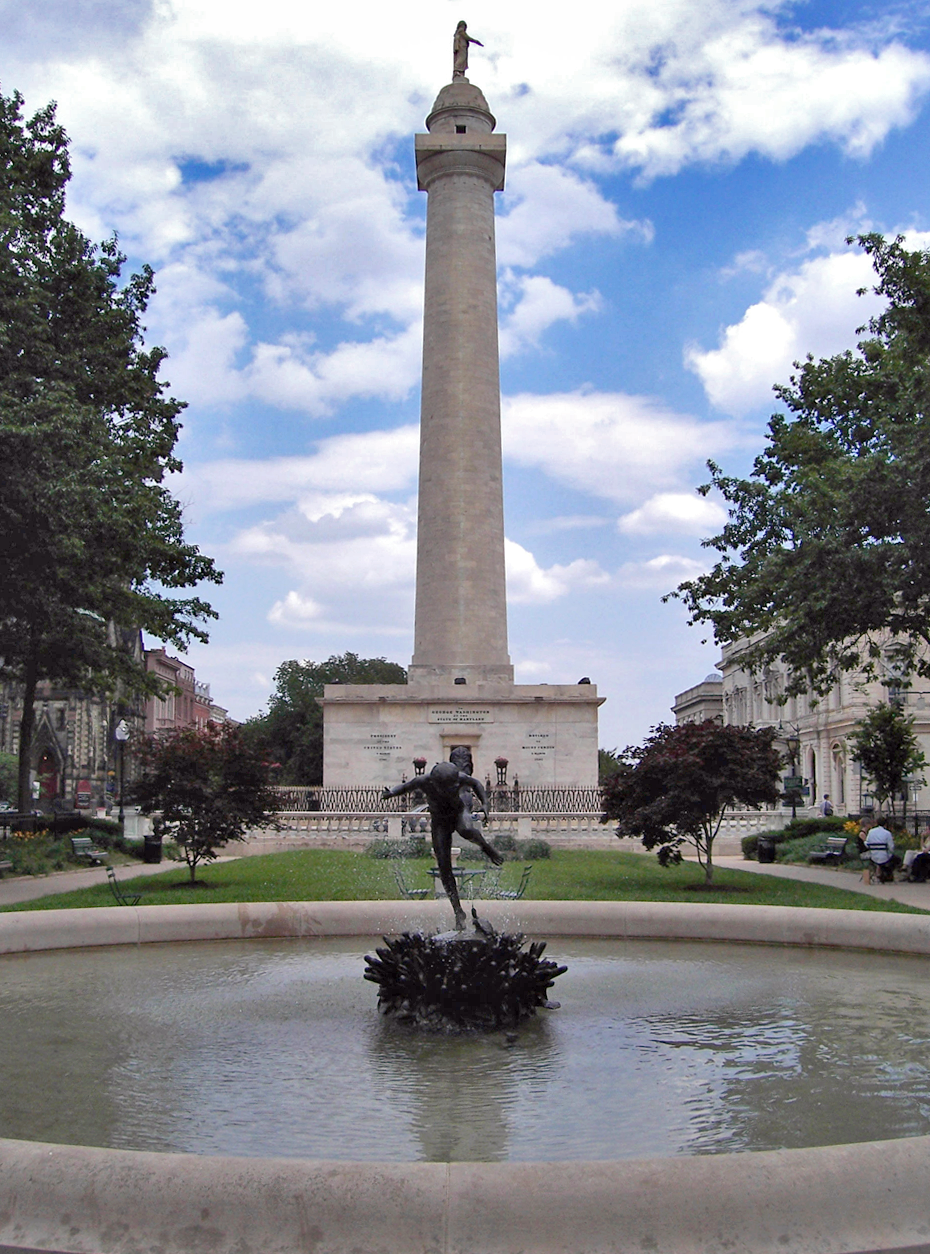
The Washington Monument


Emerson Bromo-Seltzer Tower, built in 1911. The tower's 15 stories have been transformed into studio spaces for visual and literary artists
Historically a working-class port town, Baltimore has sometimes been dubbed a "city of neighborhoods", with 72 designated historic districts[207] traditionally occupied by distinct ethnic groups. Most notable today are three downtown areas along the port: the Inner Harbor, frequented by tourists because of its hotels, shops, and museums; Fells Point, once a favorite entertainment spot for sailors but now refurbished and gentrified (and featured in the movie Sleepless in Seattle); and Little Italy, located between the other two, where Baltimore's Italian-American community is based – and where U.S. House Speaker Nancy Pelosi grew up. Further inland, Mount Vernon is the traditional center of cultural and artistic life of the city; it is home to a distinctive Washington Monument, set atop a hill in a 19th-century urban square, that predates the monument in Washington, D.C. by several decades. Baltimore also has a significant German American population,[208] and was the second largest port of immigration to the United States, behind Ellis Island in New York and New Jersey. Between 1820 and 1989, almost 2 million who were German, Polish, English, Irish, Russian, Lithuanian, French, Ukrainian, Czech, Greek and Italian came to Baltimore, most between the years 1861 to 1930. By 1913, when Baltimore was averaging forty thousand immigrants per year, World War I closed off the flow of immigrants. By 1970, Baltimore's heyday as an immigration center was a distant memory. There also was a Chinatown dating back to at least the 1880s which consisted of no more than 400 Chinese residents. A local Chinese-American association remains based there, but only one Chinese restaurant as of 2009.
Baltimore has quite a history when it comes to making beer, an art that thrived in Baltimore from the 1800s to the 1950s with over 100 old breweries in the city's past.[209] The best remaining example of that history is the old American Brewery Building on North Gay Street and the National Brewing Company building in the Brewer's Hill neighborhood. In the 1940s the National Brewing Company introduced the nation's first six-pack. National's two most prominent brands, were National Bohemian Beer colloquially "Natty Boh" and Colt 45. Listed on the Pabst website as a "Fun Fact", Colt 45 was named after running back #45 Jerry Hill of the 1963 Baltimore Colts and not the .45 caliber handgun ammunition round. Both brands are still made today, albeit outside of Maryland, and served all around the Baltimore area at bars, as well as Orioles and Ravens games.[210] The Natty Boh logo appears on all cans, bottles, and packaging; and merchandise featuring him can still easily be found in shops in Maryland, including several in Fells Point.
Each year the Artscape takes place in the city in the Bolton Hill neighborhood, close to the Maryland Institute College of Art. Artscape styles itself as the "largest free arts festival in America".[211] Each May, the Maryland Film Festival takes place in Baltimore, using all five screens of the historic Charles Theatre as its anchor venue. Many movies and television shows have been filmed in Baltimore. Homicide: Life on the Street was set and filmed in Baltimore, as well as The Wire. House of Cards and Veep are set in Washington, D.C. but filmed in Baltimore.[212]
Baltimore has cultural museums in many areas of study. The Baltimore Museum of Art, and the Walters Art Museum are internationally renowned for its collection of art. The Baltimore Museum of Art has the largest holding of works by Henri Matisse in the world.[213] The American Visionary Art Museum has been designated by Congress as America's national museum for visionary art.[214] The National Great Blacks In Wax Museum is the first African American wax museum in the country, featuring more than 150 life-size and lifelike wax figures.[48]
Cuisine
Baltimore is known for its Maryland blue crabs, crab cake, Old Bay Seasoning, pit beef, and the "chicken box". The city has many restaurants in or around the Inner Harbor. The most known and acclaimed are the Charleston, Woodberry Kitchen, and the Charm City Cakes bakery featured on the Food Network's Ace of Cakes. The Little Italy neighborhood's biggest draw is the food. Fells Point also is a foodie neighborhood for tourists and locals and is where the oldest continuously running tavern in the country, "The Horse You Came in on Saloon", is located.[215] Many of the city's upscale restaurants can be found in Harbor East. Five public markets are located across the city. The Baltimore Public Market System is the oldest continuously operating public market system in the United States.[216] Lexington Market is one of the longest-running markets in the world and longest running in the country, having been around since 1782. The market continues to stand at its original site. Baltimore is the last place in America where one can still find arabbers, vendors who sell fresh fruits and vegetables from a horse-drawn cart that goes up and down neighborhood streets.[217] Food- and drink-rating site Zagat ranked Baltimore second in a list of the 17 best food cities in the country in 2015.[218]
Local dialect
Baltimore city, along with its surrounding regions, is home to a unique local dialect known as the Baltimore dialect. It is part of the larger Mid-Atlantic American English group and is noted to be very similar to the Philadelphia dialect.[219][220]
The so-called "Bawlmerese" accent is known for its characteristic pronunciation of its long "o" vowel, in which an "eh" sound is added before the long "o" sound (/oʊ/ shifts to [ɘʊ], or even [eʊ]).[221] It also adopts Philadelphia's pattern of the short "a" sound, such that the tensed vowel in words like "bath" or "ask" does not match the more relaxed one in "sad" or "act".[219]
Baltimore native John Waters parodies the city and its dialect extensively in his films. Most are filmed in Baltimore, including the 1972 cult classic Pink Flamingos, as well as Hairspray and its Broadway musical remake.
Script error: No such module "Labelled list hatnote".
Performing arts
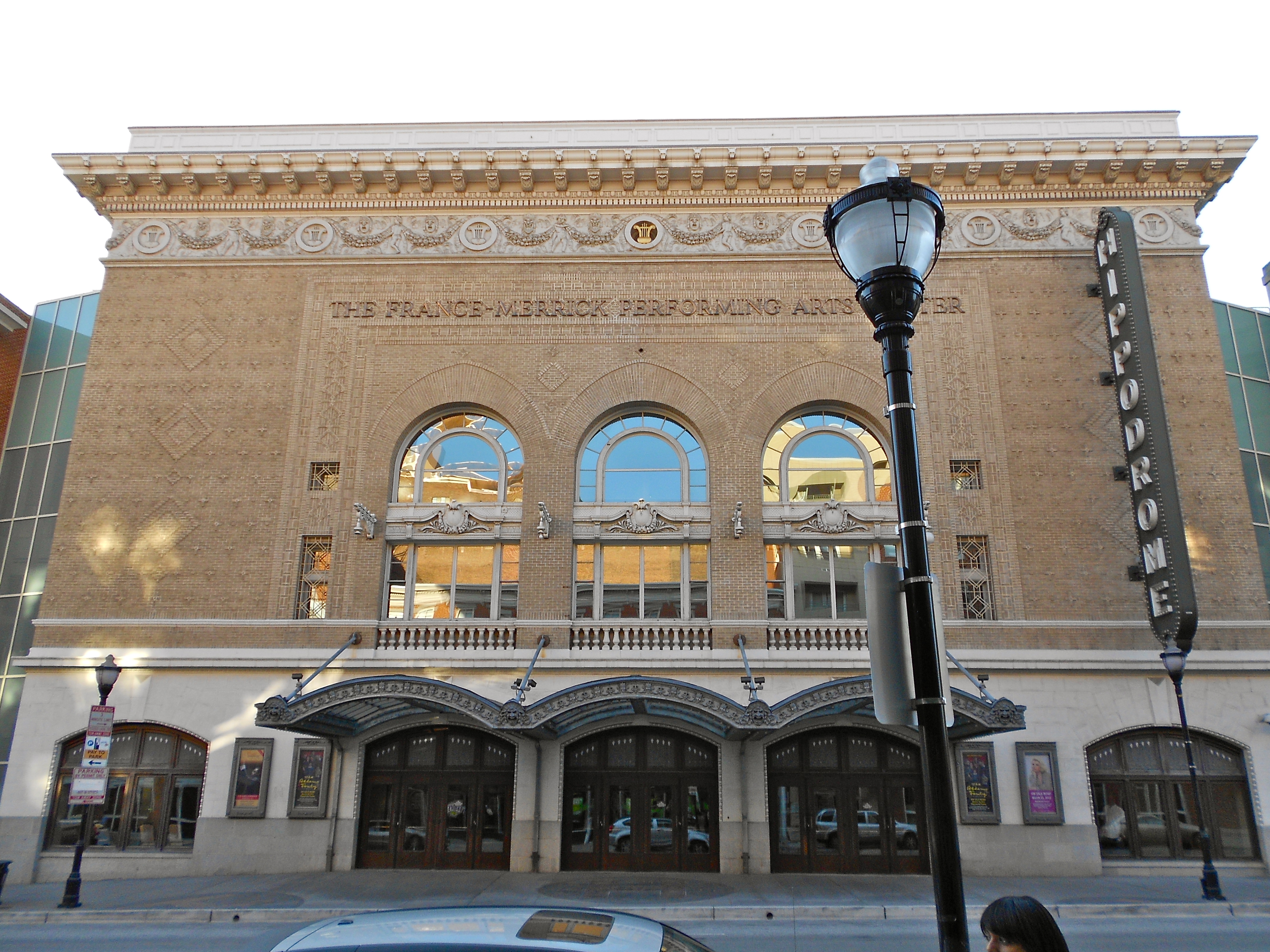

Hippodrome Theatre
Baltimore has four state-designated arts and entertainment (A & E) districts. The Pennsylvania Avenue Black Arts & Entertainment District, Station North Arts and Entertainment District, Highlandtown Arts District, and the Bromo Arts & Entertainment District. [222][223][224]
The Baltimore Office of Promotion & The Arts, a non-profit organization, produces events and arts programs as well as managing several facilities. It is the official Baltimore City Arts Council. BOPA coordinates Baltimore's major events, including New Year's Eve and July 4 celebrations at the Inner Harbor, Artscape, which is America's largest free arts festival, Baltimore Book Festival, Baltimore Farmers' Market & Bazaar, School 33 Art Center's Open Studio Tour, and the Dr. Martin Luther King Jr. Parade.[225]
The Baltimore Symphony Orchestra is an internationally renowned orchestra, founded in 1916 as a publicly funded municipal organization. Its most recent music director was Marin Alsop, a protégé of Leonard Bernstein's. Centerstage is the premier theater company in the city and a regionally well-respected group. The Lyric Opera House is the home of Lyric Opera Baltimore, which operates there as part of the Patricia and Arthur Modell Performing Arts Center. The Baltimore Consort has been a leading early music ensemble for over twenty-five years. The France-Merrick Performing Arts Center, home of the restored Thomas W. Lamb-designed Hippodrome Theatre, has afforded Baltimore the opportunity to become a major regional player in the area of touring Broadway and other performing arts presentations. Renovating Baltimore's historic theatres has become widespread throughout the city; renovated theatres include the Everyman, Centre, Senator, and most recently Parkway Theatre. Other buildings have been reused; these include the former Mercantile Deposit and Trust Company bank building, which is now The Chesapeake Shakespeare Company Theater.
Baltimore also boasts a wide array of professional (non-touring) and community theater groups. Aside from Center Stage, resident troupes in the city include The Vagabond Players, the oldest continuously operating community theater group in the country, Everyman Theatre, Single Carrot Theatre, and Baltimore Theatre Festival. Community theaters in the city include Fells Point Community Theatre and the Arena Players Inc., which is the nation's oldest continuously operating African American community theater.[226] In 2009, the Baltimore Rock Opera Society, an all-volunteer theatrical company, launched its first production.[227]
Baltimore is home to the Pride of Baltimore Chorus, a three-time international silver medalist women's chorus, affiliated with Sweet Adelines International. The Maryland State Boychoir is located in the northeastern Baltimore neighborhood of Mayfield.
Baltimore is the home of non-profit chamber music organization Vivre Musicale. VM won a 2011–2012 award for Adventurous Programming from the American Society of Composers, Authors and Publishers and Chamber Music America.[228]
The Peabody Institute, located in the Mount Vernon neighborhood, is the oldest conservatory of music in the United States.[229] Established in 1857, it is one of the most prestigious in the world,[229] along with Juilliard, Eastman, and the Curtis Institute. The Morgan State University Choir is also one of the nation's most prestigious university choral ensembles.[230] The city is home to the Baltimore School for the Arts, a public high school in the Mount Vernon neighborhood of Baltimore. The institution is nationally recognized for its success in preparation for students entering music (vocal/instrumental), theatre (acting/theater production), dance, and visual arts.
In 1981, Baltimore hosted the first International Theater Festival, the first such festival in the country. Executive producer Al Kraizer staged 66 performances of nine shows by international theatre companies, including from Ireland, the United Kingdom, South Africa and Israel.[231] However, the festival proved to be expensive to mount, and the following year the festival was hosted in Denver, called the World Theatre Festival,[232] at the Denver Center for Performing Arts, after the city had asked Kraizer to organize it.[233]
In June 1986, the 20th Theatre of Nations, sponsored by the International Theatre Institute, was held in Baltimore – the first time it had been held in the U.S.[234]
Sports
Baseball
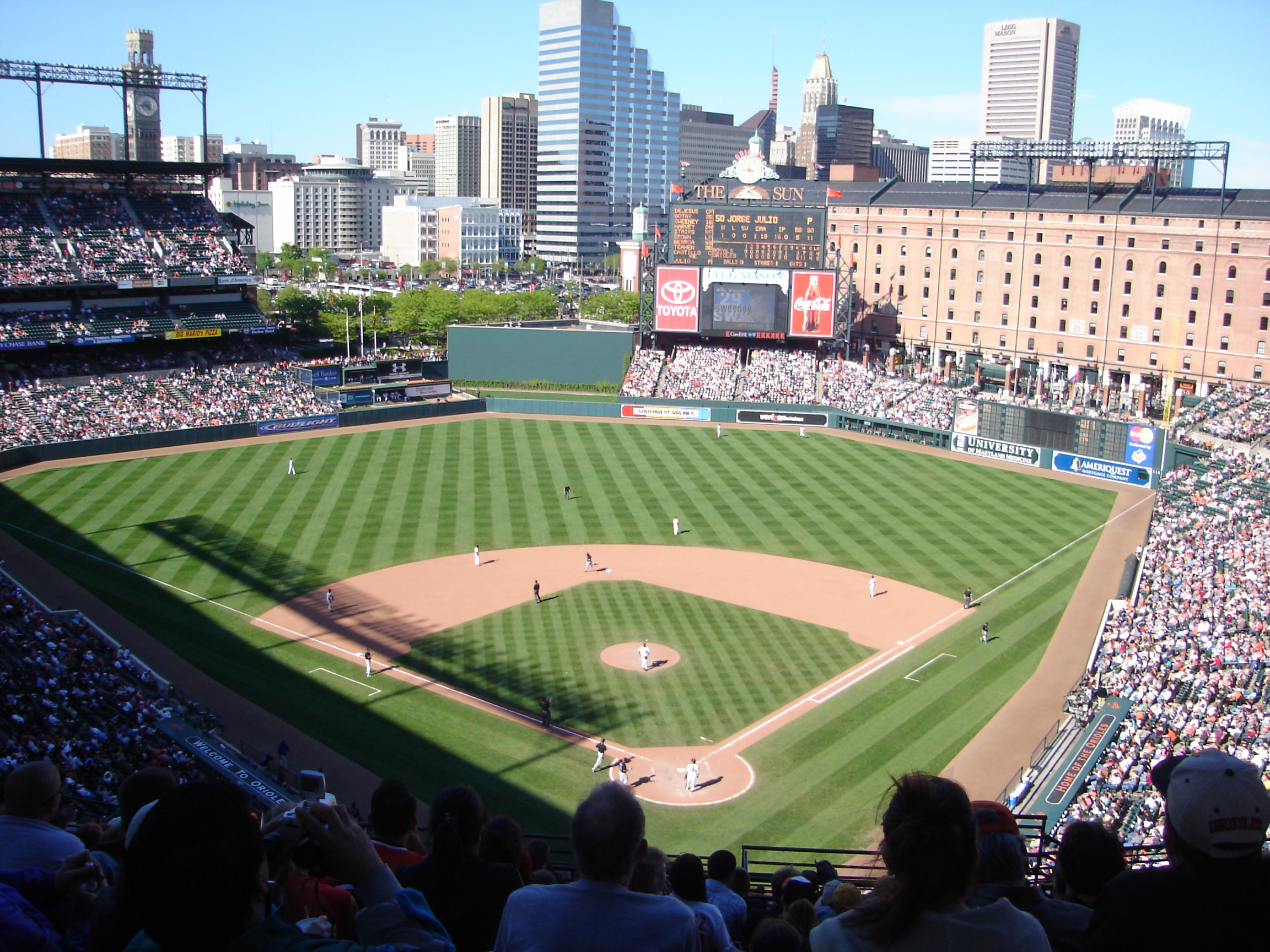

Oriole Park at Camden Yards
Baltimore has a long and storied baseball history, including its distinction as the birthplace of Babe Ruth in 1895. The original 19th century Baltimore Orioles were one of the most successful early franchises, featuring numerous hall of famers during its years from 1882 to 1899. As one of the eight inaugural American League franchises, the Baltimore Orioles played in the AL during the 1901 and 1902 seasons. The team moved to New York City before the 1903 season and was renamed the New York Highlanders, which later became the New York Yankees. Ruth played for the minor league Baltimore Orioles team, which was active from 1903 to 1914. After playing one season in 1915 as the Richmond Climbers, the team returned the following year to Baltimore, where it played as the Orioles until 1953.[Citation needed]
The team currently known as the Baltimore Orioles has represented Major League Baseball locally since 1954 when the St. Louis Browns moved to the city of Baltimore. The Orioles advanced to the World Series in 1966, 1969, 1970, 1971, 1979 and 1983, winning three times (1966, 1970 and 1983), while making the playoffs all but one year (1972) from 1969 through 1974.[235]
In 1995, local player (and later Hall of Famer) Cal Ripken Jr. broke Lou Gehrig's streak of 2,130 consecutive games played, for which Ripken was named Sportsman of the Year by Sports Illustrated magazine.[Citation needed] Six former Orioles players, including Ripken (2007), and two of the team's managers have been inducted into the Baseball Hall of Fame.
Since 1992, the Orioles' home ballpark has been Oriole Park at Camden Yards, which has been hailed as one of the league's best since it opened.[Citation needed]
Football


M&T Bank Stadium
Prior to an NFL team moving to Baltimore, there had been several attempts at a professional football team prior to the 1950s, which were blocked by the Washington team and its NFL friends. Most were minor league or semi-professional teams. The first major league to base a team in Baltimore was the All-America Football Conference (AAFC), which had a team named the Baltimore Colts. The AAFC Colts played for three seasons in the AAFC (1947, 1948, and 1949), and when the AAFC folded following the 1949 season, moved to the NFL for a single year (1950) before going bankrupt. Three years later, the NFL's Dallas Texans would itself fold. Its assets and player contracts purchased by an ownership team headed by Baltimore businessman Carroll Rosenbloom, who moved the team to Baltimore, establishing a new team also named the Baltimore Colts. During the 1950s and 1960s, the Colts were one of the NFLs more successful franchises, led by Pro Football Hall of Fame quarterback Johnny Unitas who set a then-record of 47 consecutive games with a touchdown pass. The Colts advanced to the NFL Championship twice (1958 & 1959) and Super Bowl twice (1969 & 1971), winning all except Super Bowl III in 1969. After the 1983 season, the team left Baltimore for Indianapolis in 1984, where they became the Indianapolis Colts.
The NFL returned to Baltimore when the former Cleveland Browns moved to Baltimore to become the Baltimore Ravens in 1996. Since then, the Ravens won a Super Bowl championship in 2000 and 2012, six AFC North division championships (2003, 2006, 2011, 2012, 2018, and 2019), and appeared in four AFC Championship Games (2000, 2008, 2011 and 2012).[236]
Baltimore also hosted a Canadian Football League franchise, the Baltimore Stallions for the 1994 and 1995 seasons. Following the 1995 season, and ultimate end to the Canadian Football League in the United States experiment, the team was sold and relocated to Montreal.
Other teams and events


The Preakness Stakes, the second leg of the Triple Crown, is run every May at Pimlico Race Course in Baltimore.
The first professional sports organization in the United States, The Maryland Jockey Club, was formed in Baltimore in 1743. Preakness Stakes, the second race in the United States Triple Crown of Thoroughbred Racing, has been held every May at Pimlico Race Course in Baltimore since 1873.
College lacrosse is a common sport in the spring, as the Johns Hopkins Blue Jays men's lacrosse team has won 44 national championships, the most of any program in history. In addition, Loyola University won its first men's NCAA lacrosse championship in 2012.
The Baltimore Blast are a professional arena soccer team that play in the Major Arena Soccer League at the SECU Arena on the campus of Towson University. The Blast have won nine championships in various leagues, including the MASL. A previous entity of the Blast played in the Major Indoor Soccer League from 1980 to 1992, winning one championship. The Baltimore Kings, a Baltimore Blast affiliate,[237] joined MASL 3 in 2021 to begin play in 2022.[238]
FC Baltimore 1729 was a semi-professional soccer club in the NPSL league, with the goal of bringing a community-oriented competitive soccer experience to the city of Baltimore. Their inaugural season started on May 11, 2018, and they played their home games at CCBC Essex Field.
The Baltimore Blues were a semi-professional rugby league club which began competition in the USA Rugby League in 2012.[239] The Baltimore Bohemians were an American soccer club which competed in the USL Premier Development League, the fourth tier of the American Soccer Pyramid. Their inaugural season started in the spring of 2012.
The Baltimore Grand Prix debuted along the streets of the Inner Harbor section of the city's downtown on September 2–4, 2011. The event played host to the American Le Mans Series on Saturday and the IndyCar Series on Sunday. Support races from smaller series were also held, including Indy Lights. After three consecutive years, on September 13, 2013, it was announced that the event would not be held in 2014 or 2015 due to scheduling conflicts.[240]
The athletic equipment company Under Armour is also based out of Baltimore. Founded in 1996 by Kevin Plank, a University of Maryland alumnus, the company's headquarters are located in Tide Point, adjacent to Fort McHenry and the Domino Sugar factory. The Baltimore Marathon is the flagship race of several races. The marathon begins at the Camden Yards sports complex and travels through many diverse neighborhoods of Baltimore, including the scenic Inner Harbor waterfront area, historic Federal Hill, Fells Point, and Canton, Baltimore. The race then proceeds to other important focal points of the city such as Patterson Park, Clifton Park, Lake Montebello, the Charles Village neighborhood and the western edge of downtown. After winding through 42.195 kilometres (26.219 mi) of Baltimore, the race ends at virtually the same point at which it starts.
The Baltimore Brigade were an Arena Football League team based in Baltimore that from 2017 to 2019 played at Royal Farms Arena. The team ceased operations along with the league in 2019.
Parks and recreation
The City of Baltimore boasts over Template:Convert/acresTemplate:Convert/test/Aon of parkland.[241] The Baltimore City Department of Recreation and Parks manages the majority of parks and recreational facilities in the city including Patterson Park, Federal Hill Park, and Druid Hill Park.[242] The city is also home to Fort McHenry National Monument and Historic Shrine, a coastal star-shaped fort best known for its role in the War of 1812. As of 2015[update], The Trust for Public Land, a national land conservation organization, ranks Baltimore 40th among the 75 largest U.S. cities.[241]
Politics and government
Baltimore is an independent city, and not part of any county. For most governmental purposes under Maryland law, Baltimore City is treated as a county-level entity. The United States Census Bureau uses counties as the basic unit for presentation of statistical information in the United States, and treats Baltimore as a county equivalent for those purposes.
Baltimore has been a Democratic stronghold for over 150 years, with Democrats dominating every level of government. In virtually all elections, the Democratic primary is the real contest.[243] As of the 2020 elections, registered Democrats outnumbered registered Republicans by almost 10-to-1.[244] No Republican has been elected to the City Council since 1939, and the city's last Republican mayor, Theodore McKeldin, left office in 1967. No Republican candidate since then has received 25 percent or more of the vote. In the 2016 and 2020 mayoral elections, the Republicans were pushed into third place by write-in and independent candidates, respectively. The last Republican candidate for president to win the city was Dwight Eisenhower in his successful reelection bid in 1956.
| Voter registration and party enrollment of Baltimore City[245] | |||||
|---|---|---|---|---|---|
| Party | Total | Percentage | |||
| Democratic | 305,086 | 76.79% | |||
| Republican | 28,327 | 7.13% | |||
| Independents, unaffiliated, and other | 63,906 | 16.08% | |||
| Total | 397,319 | 100.00% | |||
The city hosted the first six Democratic National Conventions, from 1832 through 1852, and hosted the DNC again in 1860, 1872, and 1912.[246][247]
City government
Mayor
Brandon Scott is the current mayor of Baltimore. He was elected in 2020 and took office on December 8, 2020. Scott succeeded Jack Young who had been mayor since May 2, 2019, upon the resignation of Catherine Pugh. Prior to Pugh's official resignation, Young was the president of the Baltimore City Council and had been the acting mayor since April 2.[248]
Catherine Pugh became the Democratic nominee for mayor in 2016 and won the mayoral election in 2016 with 57.1% of the vote; Pugh took office as mayor on December 6, 2016.[249] Pugh took a leave of absence in April 2019 due to health concerns, then officially resigned from office on May 2.[250] The resignation coincided with a scandal over a "self-dealing" book-sales arrangement.[251]
Stephanie Rawlings-Blake assumed the office of Mayor on February 4, 2010, when predecessor Dixon's resignation became effective.[252] Rawlings-Blake had been serving as City Council President at the time. She was elected to a full term in 2011, defeating Pugh in the primary election and receiving 84% of the vote.[253]
Sheila Dixon became the first female mayor of Baltimore on January 17, 2007. As the former City Council President, she assumed the office of Mayor when former Mayor Martin O'Malley took office as Governor of Maryland.[254] On November 6, 2007, Dixon won the Baltimore mayoral election. Mayor Dixon's administration ended less than three years after her election, the result of a criminal investigation that began in 2006 while she was still City Council President. She was convicted on a single misdemeanor charge of embezzlement on December 1, 2009. A month later, Dixon made an Alford plea to a perjury charge and agreed to resign from office; Maryland, like most states, does not allow convicted felons to hold office.[255][256]


Baltimore City Hall
Baltimore City Council
Grassroots pressure for reform, voiced as Question P, restructured the city council in November 2002, against the will of the mayor, the council president, and the majority of the council. A coalition of union and community groups, organized by the Association of Community Organizations for Reform Now (ACORN), backed the effort.[257]
The Baltimore City Council is now made up of 14 single-member districts and one elected at-large council president. Current members of the council are Nick Mosby, Danielle McCray, Zeke Cohen, Ryan Dorsey, Mark Conway, Isaac Schleifer, Sharon Middleton, James Torrence, Kristerfer Burnett, John Bullock, Phylicia Porter, Eric Costello, Robert Stokes, Sr., Antonio Glover, and Odette Ramos. Nick Mosby has been the council president since November 2020, when he was elected to succeed the role from Mayor Brandon Scott.[258][259]
Law enforcement
The Baltimore City Police Department, founded 1784 as a "Night City Watch" and day Constables system and later reorganized as a City Department in 1853, with a following reorganization under State of Maryland supervision in 1859, with appointments made by the Governor of Maryland after a disturbing period of civic and elections violence with riots in the later part of the decade, is the current primary law enforcement agency serving the citizens of the City of Baltimore. Campus and building security for the city's public schools is provided by the Baltimore City Public Schools Police, established in the 1970s.
In the period of 2011–2015, 120 lawsuits were brought against Baltimore police for alleged brutality and misconduct. The Freddie Gray settlement of $6.4 million exceeds the combined total settlements of the 120 lawsuits, as state law caps such payments.[260]
The Maryland Transportation Authority Police under the Maryland Department of Transportation, (originally established as the "Baltimore Harbor Tunnel Police" when opened in 1957) is the primary law enforcement agency on the Fort McHenry Tunnel Thruway (Interstate 95), the Baltimore Harbor Tunnel Thruway (Interstate 895), which go under the Northwest Branch of the Patapsco River, and Interstate 395, which has three ramp bridges crossing the Middle Branch of the Patapsco River which are under MdTA jurisdiction, the Baltimore-Washington International Airport, (BWI) and have limited concurrent jurisdiction with the Baltimore City Police Department under a "memorandum of understanding".


Courthouse east is a historic combined post office and Federal courthouse located in Battle Monument Square.
Law enforcement on the fleet of transit buses and transit rail systems serving Baltimore is the responsibility of the Maryland Transit Administration Police, which is part of the Maryland Transit Administration of the state Department of Transportation. The MTA Police also share jurisdiction authority with the Baltimore City Police, governed by a memorandum of understanding.[261]
As the enforcement arm of the Baltimore circuit and district court system, the Baltimore City Sheriff's Office, created by state constitutional amendment in 1844, is responsible for the security of city courthouses and property, service of court-ordered writs, protective and peace orders, warrants, tax levies, prisoner transportation and traffic enforcement. Deputy Sheriffs are sworn law enforcement officials, with full arrest authority granted by the constitution of Maryland, the Maryland Police and Correctional Training Commission and the Sheriff of the City of Baltimore.[262]
The United States Coast Guard, operating out of their shipyard and facility (since 1899) at Arundel Cove on Curtis Creek, (off Pennington Avenue extending to Hawkins Point Road/Fort Smallwood Road) in the Curtis Bay section of southern Baltimore City and adjacent northern Anne Arundel County. The U.S.C.G. also operates and maintains a presence on Baltimore and Maryland waterways in the Patapsco River and Chesapeake Bay. "Sector Baltimore" is responsible for commanding law enforcement and search & rescue units as well as aids to navigation.
Baltimore City Fire Department
The city of Baltimore is protected by the over 1,800 professional firefighters of the Baltimore City Fire Department (BCFD), which was founded in December 1858 and began operating the following year. Replacing several warring independent volunteer companies since the 1770s and the confusion resulting from a riot involving the "Know-Nothing" political party two years before, the establishment of a unified professional fire fighting force was a major advance in urban governance. The BCFD operates out of 37 fire stations located throughout the city and has a long history and sets of traditions in its various houses and divisions.
State government
Script error: No such module "Labelled list hatnote".
 | This article may need to be updated. Please update this article to reflect recent events or newly available information, and remove this template when finished. Please see the talk page for more information. (December 2019) |
Since the legislative redistricting in 2002, Baltimore has had six legislative districts located entirely within its boundaries, giving the city six seats in the 47-member Maryland Senate and 18 in the 141-member Maryland House of Delegates.[263][264] During the previous 10-year period, Baltimore had four legislative districts within the city limits, but four others overlapped the Baltimore County line.[265] As of January 2011[update], all of Baltimore's state senators and delegates were Democrats.[263]
State agencies
Script error: No such module "Labelled list hatnote".
Federal government
Script error: No such module "Labelled list hatnote". Two of the state's eight congressional districts include portions of Baltimore: the 2nd, represented by Dutch Ruppersberger and the 7th, represented by Kweisi Mfume. Both are Democrats; a Republican has not represented a significant portion of Baltimore in Congress since John Boynton Philip Clayton Hill represented the 3rd District in 1927, and has not represented any of Baltimore since the Eastern Shore-based 1st District lost its share of Baltimore after the 2000 census; it was represented by Republican Wayne Gilchrest at the time.
Maryland's senior United States senator, Ben Cardin, is from Baltimore. He is one of three people in the last four decades to have represented the 3rd District before being elected to the United States Senate. Paul Sarbanes represented the 3rd from 1971 until 1977, when he was elected to the first of five terms in the Senate. Sarbanes was succeeded by Barbara Mikulski, who represented the 3rd from 1977 to 1987. Mikulski was succeeded by Cardin, who held the seat until handing it to John Sarbanes upon his election to the Senate in 2007.[266]
Template:PresHead Template:PresRow Template:PresRow Template:PresRow Template:PresRow Template:PresRow Template:PresRow Template:PresRow Template:PresRow Template:PresRow Template:PresRow Template:PresRow Template:PresRow Template:PresRow Template:PresRow Template:PresRow Template:PresRow Template:PresRow Template:PresRow Template:PresRow Template:PresRow Template:PresRow Template:PresRow Template:PresRow Template:PresRow Template:PresRow Template:PresRow Template:PresRow Template:PresRow Template:PresRow Template:PresRow Template:PresRow Template:PresRow Template:PresRow |}
The Postal Service's Baltimore Main Post Office is located at 900 East Fayette Street in the Jonestown area.[267]
The national headquarters for the United States Social Security Administration is located in Woodlawn, just outside of Baltimore.
Education
Script error: No such module "Labelled list hatnote".
Colleges and universities
Baltimore is the home of numerous places of higher learning, both public and private. 100,000 college students from around the country attend Baltimore City's 12 accredited two-year or four-year colleges and universities.[268][269] Among them are:
Private


Keyser Quadrangle in Spring at the Johns Hopkins University the first research university in the United States.


Interior of the George Peabody Library at the Peabody Institute of Johns Hopkins University. The library is renowned for its beauty.[270]
- Johns Hopkins University
- Baltimore International College
- Loyola University Maryland
- Maryland Institute College of Art
- St. Mary's Seminary and University
- Notre Dame of Maryland University
- The Peabody Institute of Johns Hopkins University
- Stratford University (Baltimore campus)
Public
- Baltimore City Community College
- Coppin State University
- Morgan State University
- University of Baltimore
- University of Maryland, Baltimore
Primary and secondary schools
The city's public schools are managed by Baltimore City Public Schools,[271] and include schools that have been well known in the area: Carver Vocational-Technical High School, the first African American vocational high school and center that was established in the state of Maryland; Digital Harbor High School, one of the secondary schools that emphasizes information technology; Lake Clifton Eastern High School, which is the largest school campus in Baltimore City of physical size; the historic Frederick Douglass High School, which is the second oldest African American high school in the United States;[272] Baltimore City College, the third oldest public high school in the country;[273] and Western High School, the oldest public all-girls school in the nation.[274] Baltimore City College (also known as "City") and Baltimore Polytechnic Institute (also known as "Poly") share the nation's second-oldest high school football rivalry.[275]
Script error: No such module "Labelled list hatnote".
Transportation
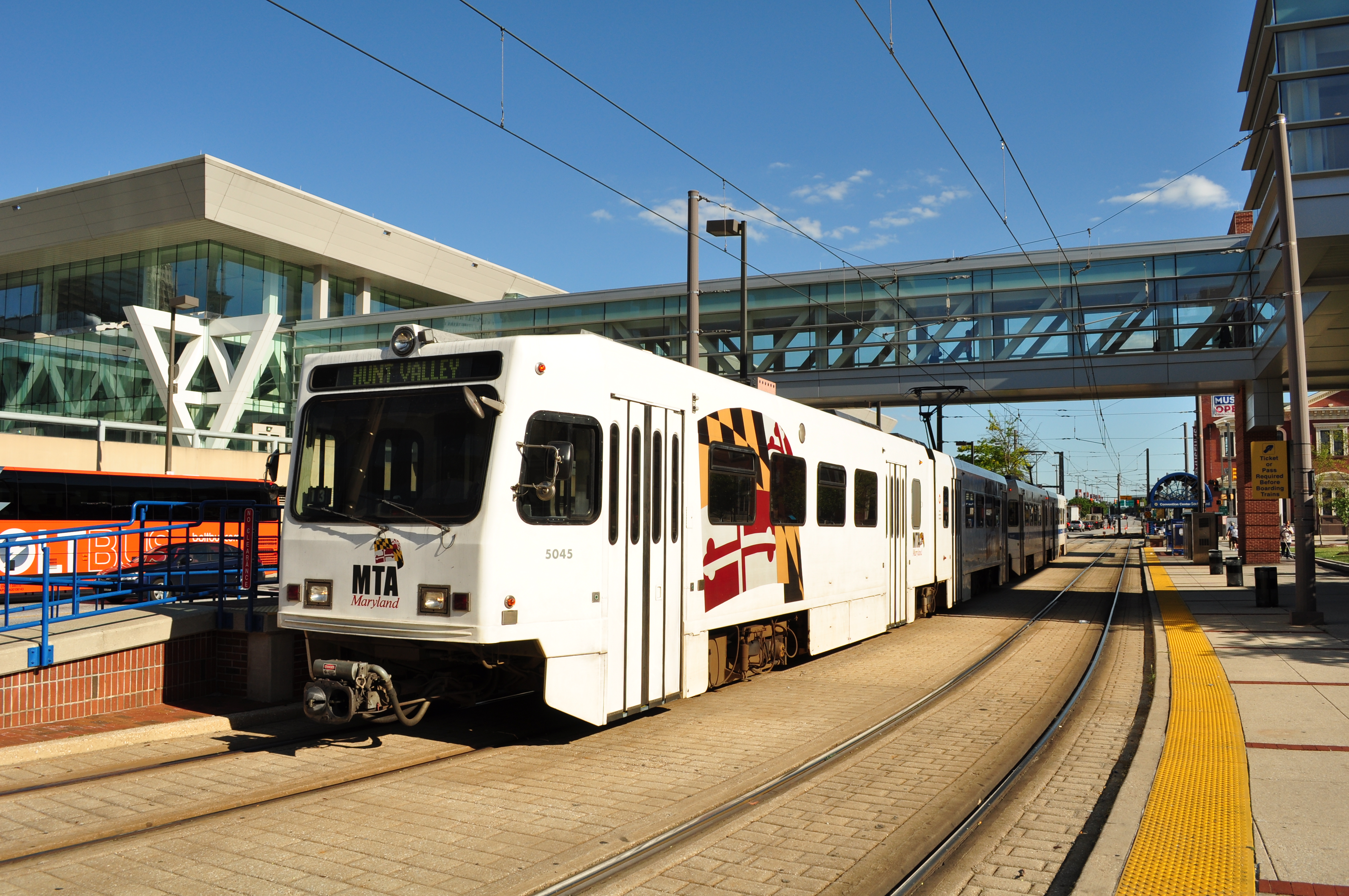

The Baltimore Light RailLink provides service to Baltimore–Washington International Thurgood Marshall Airport and the Baltimore area. Here, a train stops at Convention Center station, just west of the Baltimore Convention Center on Pratt Street.
The city of Baltimore has a higher-than-average percentage of households without a car. In 2015, 30.7 percent of Baltimore households lacked a car, which decreased slightly to 28.9 percent in 2016. The national average was 8.7 percent in 2016. Baltimore averaged 1.65 cars per household in 2016, compared to a national average of 1.8.[276]
Roads and highways
Baltimore's highway growth has done much to influence the development of the city and its suburbs. The first limited-access highway serving Baltimore was the Baltimore–Washington Parkway, which opened in stages between 1950 and 1954. Maintenance of it is split: the half closest to Baltimore is maintained by the state of Maryland, and the half closest to Washington by the National Park Service. Trucks are only permitted to use the northern part of the parkway. Trucks (tractor-trailers) continued to use U.S. Route 1 (US 1) until Interstate 95 (I-95) between Baltimore and Washington opened in 1971.
The Interstate highways serving Baltimore are I-70, I-83 (the Jones Falls Expressway), I-95, I-395, I-695 (the Baltimore Beltway), I-795 (the Northwest Expressway), I-895 (the Harbor Tunnel Thruway), and I-97. The city's mainline Interstate highways—I-95, I-83, and I-70—do not directly connect to each other, and in the case of I-70 end at a park and ride lot just inside the city limits, because of freeway revolts in Baltimore. These revolts were led primarily by Barbara Mikulski, a former United States senator for Maryland, which resulted in the abandonment of the original plan. There are two tunnels traversing Baltimore Harbor within the city limits: the four-bore Fort McHenry Tunnel (opened in 1985 and serving I-95) and the two-bore Harbor Tunnel (opened in 1957 and serving I-895). The Baltimore Beltway crosses south of Baltimore Harbor over the Francis Scott Key Bridge.
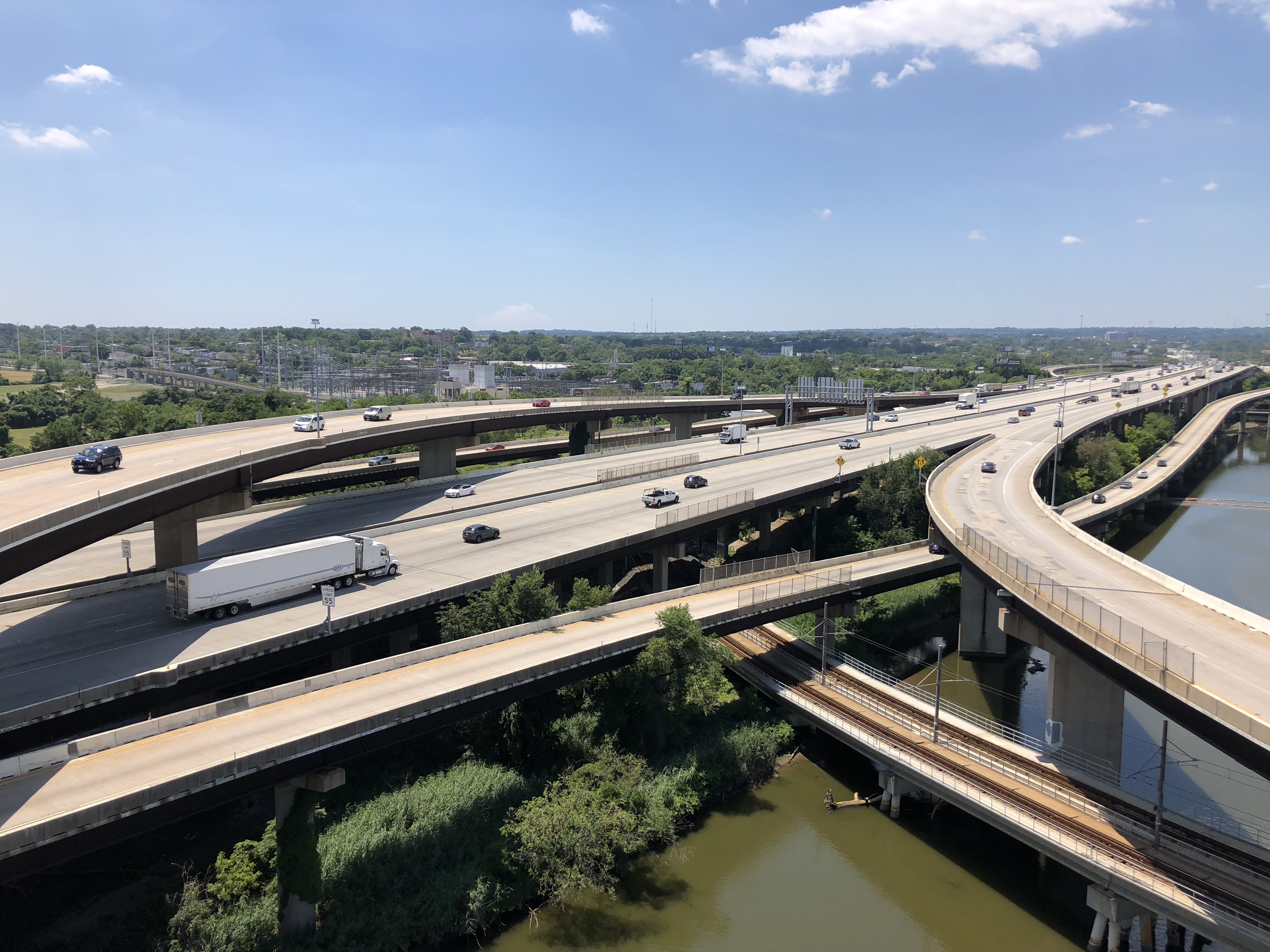
_at_its_junction_with_Interstate_95_from_the_overpass_for_the_ramp_from_Interstate_395_southbound_to_Interstate_95_northbound_in_Baltimore_City,_Maryland.jpg)
View south along I-95 from the ramp from I-395 to I-95 northbound in Baltimore
The first interstate highway built in Baltimore was I-83, called the Jones Falls Expressway (first portion built in the early 1960s). Running from the downtown toward the northwest (NNW), it was built through a natural corridor, which meant that no residents or housing were directly affected. A planned section from what is now its southern terminus to I-95 was abandoned. Its route through parkland received criticism.
Planning for the Baltimore Beltway antedates the creation of the Interstate Highway System. The first portion completed was a small strip connecting the two sections of I-83, the Baltimore-Harrisburg Expressway and the Jones Falls Expressway.
The only U.S. Highways in the city are US 1, which bypasses downtown, and US 40, which crosses downtown from east to west. Both run along major surface streets; however, US 40 utilizes a small section of a freeway cancelled in the 1970s in the west side of the city originally intended for Interstate 170. State routes in the city also travel along surface streets, with the exception of Maryland Route 295, which carries the Baltimore–Washington Parkway.
The Baltimore City Department of Transportation (BCDOT) is responsible for several functions of the road transportation system in Baltimore, including repairing roads, sidewalks, and alleys; road signs; street lights; and managing the flow of transportation systems.[277] In addition, the agency is in charge of vehicle towing and traffic cameras.[278][279] BCDOT maintains all streets within the city of Baltimore. These include all streets that are marked as state and U.S. highways as well as the portions of I-83 and I-70 within the city limits. The only highways within the city that are not maintained by BCDOT are I-95, I-395, I-695, and I-895; those four highways are maintained by the Maryland Transportation Authority.[280]
Transit systems
Public transit


Charm City Circulator Van Hool A330#1101 on the Orange Line
Public transit in Baltimore is mostly provided by the Maryland Transit Administration (abbreviated "MTA Maryland") and Charm City Circulator. MTA Maryland operates a comprehensive bus network, including many local, express, and commuter buses, a light rail network connecting Hunt Valley in the north to BWI Airport and Cromwell (Glen Burnie) in the south, and a subway line between Owings Mills and Johns Hopkins Hospital.[281] A proposed rail line, known as the Red Line, which would link the Social Security Administration to Johns Hopkins Bayview Medical Center and perhaps the Canton and Dundalk communities, was cancelled as of June 2015[update] by Governor Larry Hogan; a proposal to extend Baltimore's existing subway line to Morgan State University, known as the Green Line, is in the planning stages.[282]
The Charm City Circulator (CCC), a shuttle bus service operated by Veolia Transportation for the Baltimore Department of Transportation, began operating in the downtown area in January 2010. Funded partly by a 16 percent increase in the city's parking fees, the circulator provides free bus service seven days a week, picking up passengers every 15 minutes at designated stops during service hours.[283][284]
The CCC's first bus line, the Orange route, travels between Hollins Market and Harbor East. Its Purple route, launched June 7, 2010, operates between Fort Avenue and 33rd St. The Green route runs between Johns Hopkins and City Hall.[284][285] The Charm City Circulator operates a fleet of diesel and hybrid vehicles built by DesignLine, Orion, and Van Hool.[283]
Baltimore also has a water taxi service, operated by Baltimore Water Taxi. The water taxi's six routes provide service throughout the city's harbor, and was purchased by Under Armour CEO Kevin Plank's Sagamore Ventures in 2016.[286]
In June 2017, The BaltimoreLink started operating; it is the redesign of the region's initial bus system. The BaltimoreLink runs through downtown Baltimore every 10 minutes via color-coded, high-frequency CityLink routes.[287]
Intercity rail


Baltimore Pennsylvania Station
Baltimore is a top destination for Amtrak along the Northeast Corridor. Baltimore's Penn Station is one of the busiest in the country. In FY 2014, Penn Station was ranked the seventh-busiest rail station in the United States by number of passengers served each year.[288] The building sits on a raised "island" of sorts between two open trenches, one for the Jones Falls Expressway and the other for the tracks of the Northeast Corridor (NEC). The NEC approaches from the south through the two-track, 7,660 feet (2,330 m) Baltimore and Potomac Tunnel, which opened in 1873 and whose Template:Convert/mphTemplate:Convert/test/Aon limit, sharp curves, and steep grades make it one of the NEC's worst bottlenecks. The NEC's northern approach is the 1873 Union Tunnel, which has one single-track bore and one double-track bore.
Just outside the city, Baltimore/Washington International (BWI) Thurgood Marshall Airport Rail Station is another stop. Amtrak's Acela Express, Palmetto, Carolinian, Silver Star, Silver Meteor, Vermonter, Crescent, and Northeast Regional trains are the scheduled passenger train services that stop in the city. Additionally, MARC commuter rail service connects the city's two main intercity rail stations, Camden Station and Penn Station, with Washington, D.C.'s Union Station as well as stops in between. The MARC consists of 3 lines; the Brunswick, Camden and Penn. On December 7, 2013, the Penn Line began weekend service.[289]
Airports


The interior of Baltimore–Washington International Thurgood Marshall Airport, Baltimore's major commercial airport
Baltimore is served by two airports, both operated by the Maryland Aviation Administration, which is part of the Maryland Department of Transportation.[290] Baltimore–Washington International Thurgood Marshall Airport, generally known as "BWI", lies about 10 miles (Template:Convert/pround km) to the south of Baltimore in neighboring Anne Arundel County. The airport is named after Thurgood Marshall, a Baltimore native who was the first African American to serve on the Supreme Court of the United States. In terms of passenger traffic, BWI is the 22nd busiest airport in the United States.[291] As of calendar year 2014, BWI is the largest, by passenger count, of three major airports serving the Baltimore–Washington Metropolitan Area. It is accessible by I-95 and the Baltimore–Washington Parkway via Interstate 195, the Baltimore Light Rail, and Amtrak and MARC Train at BWI Rail Station.
Baltimore is also served by Martin State Airport, a general aviation facility, to the northeast in Baltimore County. Martin State Airport is linked to downtown Baltimore by Maryland Route 150 (Eastern Avenue) and by MARC Train at its own station.
Pedestrians and bicycles
Baltimore has a comprehensive system of bicycle routes in the city. These routes are not numbered, but are typically denoted with green signs displaying a silhouette of a bicycle upon an outline of the city's border, and denote the distance to destinations, much like bicycle routes in the rest of the state. The roads carrying bicycle routes are also labelled with either bike lanes, sharrows, or Share the Road signs. Many of these routes pass through the downtown area. The network of bicycle lanes in the city continues to expand, with over 140 miles (230 km) added between 2006 and 2014.[292] Alongside bike lanes, Baltimore has also built bike boulevards, starting with Guilford Avenue in 2012.
Baltimore currently has three major trail systems within the city. The Gwynns Falls Trail runs from the Inner Harbor to the I-70 Park and Ride, passing through Gwynns Falls Park and possessing numerous branches. There are also many pedestrian hiking trails traversing the park. The Jones Falls Trail currently runs from the Inner Harbor to the Cylburn Arboretum; however, it is currently undergoing expansion. Long-term plans call for it to extend to the Mount Washington Light Rail Stop, and possibly as far north as the Falls Road stop to connect to the Robert E. Lee boardwalk north of the city. It will also incorporate a spur alongside Western Run. The two aforementioned trails carry sections of the East Coast Greenway through the city. There is also the Herring Run Trail, which runs from Harford Road east to its end beyond Sinclair Lane, utilizing Herring Run Park; long-term plans also call for its extension to Morgan State University and north to points beyond. Other major bicycle projects include a protected cycle track installed on both Maryland Avenue and Mount Royal Avenue, expected to become the backbone of a downtown bicycle network. Installation for the cycletracks is expected in 2014 and 2016, respectively.
In addition to the bicycle trails and cycletracks, Baltimore has the Stony Run Trail, a walking path that will eventually connect from the Jones Falls north to Northern Parkway, utilizing much of the old Ma and Pa Railroad corridor inside the city. In 2011, the city undertook a campaign to reconstruct many sidewalk ramps in the city, coinciding with mass resurfacing of the city's streets. A 2011 study by Walk Score ranked Baltimore the 14th most walkable of fifty largest U.S. cities.[293]
Port of Baltimore
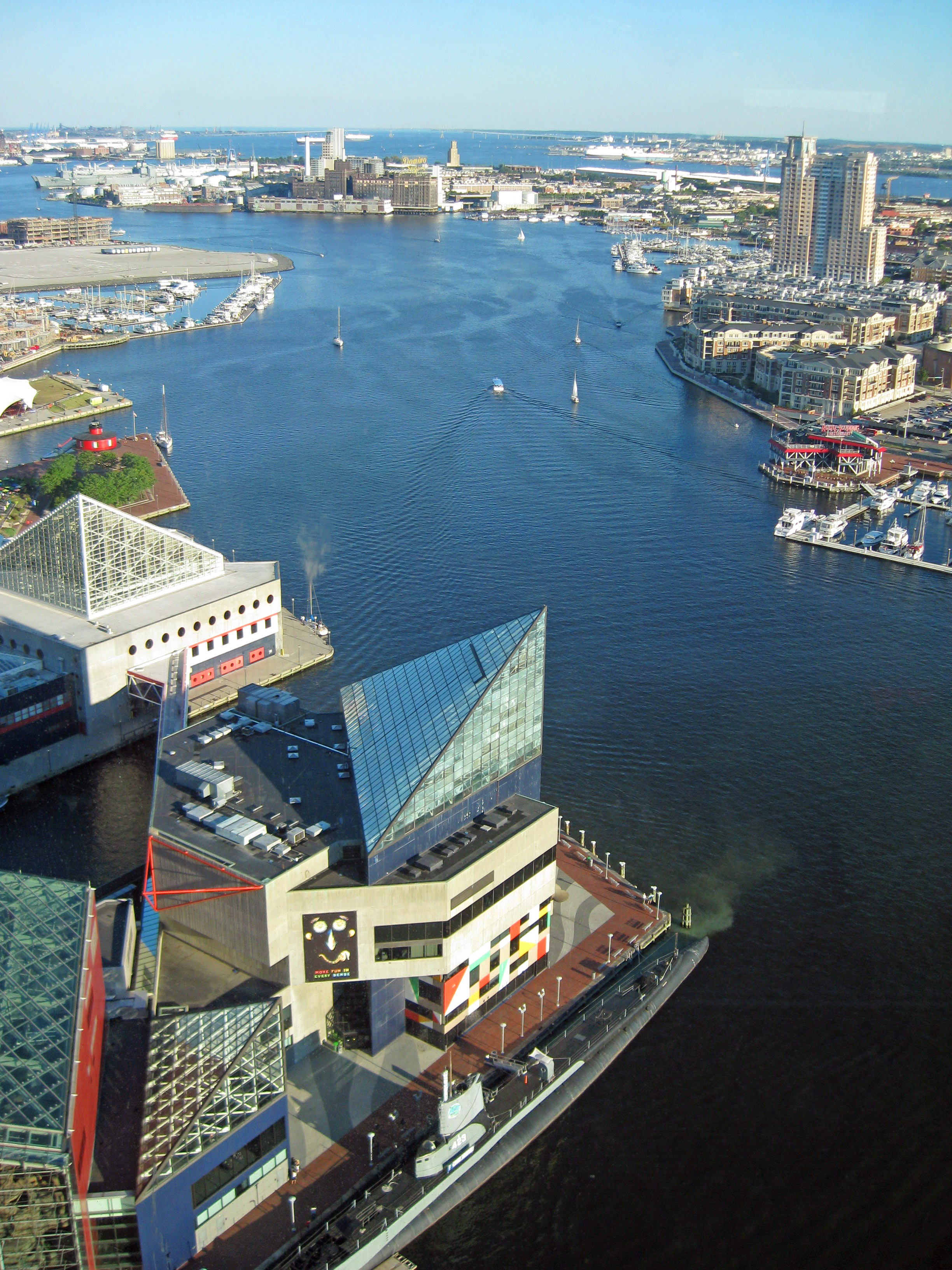

Eastward view Baltimore's Inner Harbor
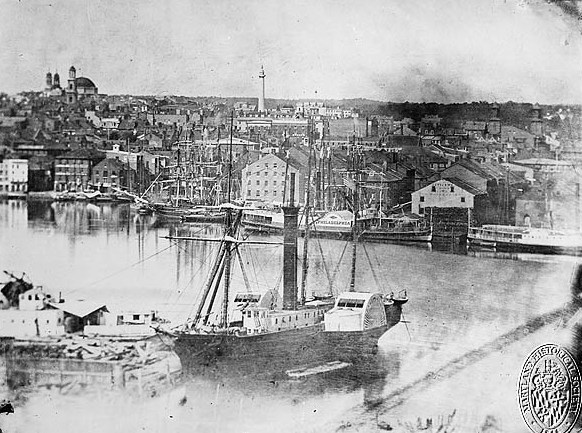

Baltimore harbor in 1849 with the prominent Washington Monument in the background north of the city

.jpg)
Francis Scott Key Bridge over the Baltimore harbor.
The port was founded in 1706, preceding the founding of Baltimore. The Maryland colonial legislature made the area near Locust Point as the port of entry for the tobacco trade with England. Fells Point, the deepest point in the natural harbor, soon became the colony's main ship building center, later on becoming leader in the construction of clipper ships.[294]
After Baltimore's founding, mills were built behind the wharves. The California Gold Rush led to many orders for fast vessels; many overland pioneers also relied upon canned goods from Baltimore. After the Civil War, a coffee ship was designed here for trade with Brazil. At the end of the nineteenth century, European ship lines had terminals for immigrants. The Baltimore and Ohio Railroad made the port a major transshipment point.[295]Template:Rp Currently the port has major roll-on/roll-off facilities, as well as bulk facilities, especially steel handling.[296]
Water taxis also operate in the Inner Harbor. Governor Ehrlich participated in naming the port after Helen Delich Bentley during the 300th anniversary of the port.[297]
In 2007, Duke Realty Corporation began a new development near the Port of Baltimore, named the Chesapeake Commerce Center. This new industrial park is located on the site of a former General Motors plant. The total project comprises Template:Convert/LoffAoffDbSoffNa in eastern Baltimore City, and the site will yield 2,800,000 square feet (260,000 m2) of warehouse/distribution and office space. Chesapeake Commerce Center has direct access to two major Interstate highways (I-95 and I-895) and is located adjacent to two of the major Port of Baltimore terminals. The Port of Baltimore is one of two seaports on the U.S. East Coast with a 50-foot (15 m) dredge to accommodate the largest shipping vessels.[298]
Along with cargo terminals, the port also has a passenger cruise terminal, which offers year-round trips on several lines, including Royal Caribbean's Grandeur of the Seas and Carnival's Pride. Overall five cruise lines have operated out of the port to the Bahamas and the Caribbean, while some ships traveled to New England and Canada. The terminal has become an embarkation point where passengers have the opportunity to park and board next to the ship visible from Interstate 95.[299] Passengers from Pennsylvania, New York and New Jersey make up a third of the volume, with travelers from Maryland, Virginia, the District and even Ohio and the Carolinas making up the rest.[300]
Environment
Baltimore's Inner Harbor, known for its skyline waterscape and its tourist-friendly areas, was horribly polluted. The waterway was often filled with garbage after heavy rainstorms, failing its 2014 water quality report card. The Waterfront Partnership of Baltimore took steps to remediate the waterways, in hopes that the harbor would be fishable and swimmable once again.
Trash interceptors

The "Mr. Trash Wheel" trash interceptor at the mouth of the Jones Falls River in Baltimore's Inner Harbor
Baltimore has four water wheel trash interceptors for removing garbage in area waterways. One is at the mouth of Jones Falls in Baltimore's Inner Harbor, dubbed "Mr. Trash Wheel."[301] Another, "Professor Trash Wheel" was added at Harris Creek in the Canton neighborhood in 2016,[302][303] with "Captain Trash Wheel" following at Mason Creek in 2018[304] and "Gwynnda, the Good Wheel of the West" at the mouth of the Gwynns Falls in 2021.[305] A February 2015 agreement with a local waste-to-energy plant is believed to make Baltimore the first city to use reclaimed waterway debris to generate electricity.[306]
Other water pollution control
In August 2010, the National Aquarium assembled, planted, and launched a floating wetland island designed by Biohabitats in Baltimore's Inner Harbor.[307] Hundreds of years ago Baltimore's harbor shoreline would have been lined with tidal wetlands. Floating wetlands provide many environmental benefits to water quality and habitat enhancement, which is why the Waterfront Partnership of Baltimore has included them in their Healthy Harbor Initiative pilot projects.[308] Biohabitats also developed a concept to transform a dilapidated wharf into a living pier that cleans Harbor water, provides habitat and is an aesthetic attraction. Currently under design, the top of the pier will become a constructed tidal wetland.[309]
Other projects to improve water quality include the Blue Alleys project, expanded street sweeping, and stream restoration.[301]
Media
Baltimore's main media outlet since 2010 is Baltimore Brew, edited by Fern Shen and Mark Reutter, investigative journalists of the Washington Post and Baltimore Sun, respectively. The Baltimore Sun was sold by its Baltimore owners in 1986 to the Times Mirror Company,[310] which was bought by the Tribune Company in 2000.[311] Since the recent sale, The Baltimore Sun prints some local news along with regional and national articles. The Baltimore News-American, another long-running paper that competed with the Sun, ceased publication in 1986.[312]
The city is home to the Baltimore Afro-American, an influential African American newspaper founded in 1892.[313][314]
In 2006, The Baltimore Examiner was launched to compete with The Sun. It was part of a national chain that includes The San Francisco Examiner and The Washington Examiner. In contrast to the paid subscription Sun, The Examiner was a free newspaper funded solely by advertisements. Unable to turn a profit and facing a deep recession, The Baltimore Examiner ceased publication on February 15, 2009.[Citation needed]
Despite being located 40 miles northeast of Washington, D.C., Baltimore is a major media market in its own right, with all major English language television networks represented in the city. WJZ-TV 13 is a CBS owned and operated station, and WBFF 45 (Fox) is the flagship of Sinclair Broadcast Group, the largest station owner in the country. Other major television stations in Baltimore include WMAR-TV 2 (ABC), WBAL-TV 11 (NBC), WUTB 24 (TBD), WBFF-DT2 45.2 (MyNetworkTV), WNUV 54 (CW), and WMPB 67 (PBS). Baltimore is also served by low-power station WMJF-CD 39 (Ion), which transmits from the campus of Towson University.
Nielsen ranked Baltimore as the 26th-largest television market for the 2008–2009 viewing season and the 27th-largest for 2009–2010.[315] Arbitron's Fall 2010 rankings identified Baltimore as the 22nd largest radio market.[316]
Notable people
- Spiro Agnew, 39th US vice president
- Cass Elliot (1941–1974), born Ellen Naomi Cohen, singer, member of The Mamas & the Papas
- Eubie Blake, early jazz pianist and composer
- Tom Clancy, author of the Jack Ryan Book Series
- Elijah Cummings, civil rights advocate and congressman of the US House of Representatives
- Gervonta Davis, professional boxer, four-time world champion in two weight classes
- Daniel Coit Gilman, founding president of Johns Hopkins University
- David Hasselhoff, actor, producer, businessman
- Kyle Harrison, professional lacrosse player, first black Tewaaraton Award recipient
- Johns Hopkins, American entrepreneur, investor, and philanthropist; namesake of Johns Hopkins University
- Thurgood Marshall, African-American US Supreme Court Justice
- H. L. Mencken, American journalist, essayist, satirist, cultural critic, and scholar of American English
- Ric Ocasek, American musician and frontman of the Cars
- Nancy Pelosi, speaker of the US House of Representatives
- Michael Phelps, Olympic swimmer
- Edgar Allan Poe, poet
- Emily Post, author of etiquette books
- Babe Ruth, baseball player
- Jada Pinkett Smith, actress, singer, and businesswoman
- M. Carey Thomas, American educator, suffragist, and linguist
- Anne Tyler, Pulitzer Prize-winning novelist
- John Waters, filmmaker
- Frank Zappa, singer, guitarist, composer, and satirist
- Julie Bowen, actress
- Muggsy Bogues, basketball player
International relations
Baltimore has ten sister cities, as designated by Sister Cities International:[317][318]
Baltimore's own Sister City Committees recognize eight of these sister cities, indicated above with a "B" notation.[319]
Three additional sister cities have "emeritus status":[317]
- Genova, Italy (1985)[320]
- Ely O'Carroll, Ireland
- Bremerhaven, Germany (2007)
See also
- Baltimore Development Corporation
- Baltimore in fiction
- Baltimore National Heritage Area
- Bluegrass in Baltimore: The Hard Drivin' Sound and Its Legacy (Book on the history of the Appalachian migrants' move into the city in the 20th century)
- History of the Germans in Baltimore, Maryland
- Category:Cemeteries in Baltimore
- Script error: No such module "portal-inline".
Explanatory notes
- ↑ The form and type of government of the city is described by Article XI of the State Constitution.
- ↑ Officially, seasonal snowfall accumulation has ranged from Template:Convert/inTemplate:Convert/test/Aon in 1949–50 to Template:Convert/inTemplate:Convert/test/Aon in 2009–10. See North American blizzard of 2009#Snowfall (December 19–20, 2009), February 5–6, 2010 North American blizzard#Snowfall, and February 9–10, 2010 North American blizzard#Impact. The February storms contributed to a monthly accumulation of Template:Convert/inTemplate:Convert/test/Aon, the most for any month.[140] If no snow fell outside of February that winter, 2009–10 would still rank as 5th snowiest.[141]
- ↑ Since 1950, when the National Weather Service switched to using the suburban and generally cooler BWI Airport as the official Baltimore climatology station, this extreme has repeated three times: January 29, 1963, January 17, 1982, and January 22, 1984.
- ↑ 4.0 4.1 From 15% sample
- ↑ Including Evangelical Protestants (19%), Mainline Protestants (16%) and Historically Black Protestants (15%).[173]
References
Citations
- ↑ 1.0 1.1 1.2 Donovan, Doug (May 20, 2006). "Baltimore's New Bait: The City is About to Unveil a New Slogan, 'Get In On It,' Meant to Intrigue Visitors". http://www.redorbit.com/news/business/511672/baltimores_new_bait_the_city_is_about_to_unveil_a/index.html.
- ↑ Kane, Gregory (June 15, 2009). "Dispatch from Bodymore, Murderland". The Washington Examiner. http://www.washingtonexaminer.com/article/37312.
- ↑ Cutler, Josh S. (February 18, 2019). Mobtown Massacre: Alexander Hanson and the Baltimore Newspaper War of 1812. ISBN 9781439666203. https://books.google.com/books?id=pAiFDwAAQBAJ.
- ↑ Gettleman, Jeffrey (September 2, 2003). "In Baltimore, Slogan Collides with Reality". The New York Times. https://www.nytimes.com/2003/09/02/us/in-baltimore-slogan-collides-with-reality.html.
- ↑ "2019 U.S. Gazetteer Files". United States Census Bureau. https://www2.census.gov/geo/docs/maps-data/data/gazetteer/2019_Gazetteer/2019_gaz_place_24.txt.
- ↑ 6.0 6.1 "Highest and Lowest Elevations in Maryland's Counties". Maryland Department of Natural Resources. Baltimore City. http://www.mgs.md.gov/esic/fs/fs1.html.
- ↑ 7.0 7.1 "Total Resident Population for Maryland's Jurisdictions, April 1, 2010 Thru July 1, 2020". Maryland Department of Planning, Projections and State Data Center Unit. May 4, 2021. https://planning.maryland.gov/MSDC/Documents/pop_estimate/Estimates/county/County-table1A.pdf.
- ↑ "List of 2020 Census Urban Areas". United States Census Bureau. https://www.census.gov/programs-surveys/geography/guidance/geo-areas/urban-rural.html.
- ↑ "2020 Population and Housing State Data". United States Census Bureau. https://www.census.gov/library/visualizations/interactive/2020-population-and-housing-state-data.html.
- ↑ Britto, Brittany. "How Baltimore talks". The Baltimore Sun. http://data.baltimoresun.com/features/baltimore-dictionary/.
- ↑ 11.0 11.1 11.2 11.3 11.4 "QuickFacts: Baltimore city (County)". United States Census Bureau. https://www.census.gov/quickfacts/fact/table/baltimorecitycountymaryland/POP010220.
- ↑ 12.0 12.1 "Metropolitan and Micropolitan Statistical Areas Population Totals: 2020–2021" (CSV). 2021 Population Estimates. United States Census Bureau, Population Division. May 2022. https://www.census.gov/data/tables/time-series/demo/popest/2020s-total-metro-and-micro-statistical-areas.html.
- ↑ "Baltimore". Encyclopaedia Britannica. August 14, 2019. https://www.britannica.com/place/Baltimore. Retrieved September 6, 2019.
- ↑ Youssi, Adam (2006). "The Susquehannocks' Prosperity & Early European Contact". Historical Society of Baltimore County. http://www.hsobc.org/on-the-susquehannocks-natives-having-previously-used-what-is-now-baltimore-county-as-hunting-grounds/.
- ↑ "About Baltimore". Baltimore.org. http://baltimore.org/about-baltimore.
- ↑ "Baltimore Heritage Area". Maryland Department of Planning. February 11, 2011. http://mht.maryland.gov/heritageareas_baltimore.html.
- ↑ "Major Employers | Baltimore Development Corporation". Baltimoredevelopment.com. http://www.baltimoredevelopment.com/major-employers.
- ↑ Gibbons, Mike (October 21, 2011). "Monumental City Welcomes Number Five". Babe Ruth Birthplace Foundation. http://baberuthmuseum.org/monumental-city-welcomes-number-five/.
- ↑ 19.0 19.1 Sherman, Natalie (March 14, 2015). "Historic districts proliferate as city considers changes". The Baltimore Sun. http://www.baltimoresun.com/business/real-estate/wonk/bs-bz-historic-districts-20150314-story.html.
- ↑ "Building on Baltimore's History: The Partnership for Building Reuse". Preservation Green Lab, National Trust for Historic Preservation and the Urban Land Institute Baltimore. November 2014. http://baltimore.uli.org/wp-content/uploads/sites/11/2014/11/NTHP-BALTIMORE-REPORT.pdf.
- ↑ 21.0 21.1 Akerson, Louise A. (1988). American Indians in the Baltimore area. Baltimore, Maryland: Baltimore Center for Urban Archaeology (Md.). p. 15. OCLC 18473413.
- ↑ Shen, Fern (December 4, 2021). "Discovered in Baltimore park: Native American artifacts 5,000-9,000 years old". Baltimore Brew. https://www.baltimorebrew.com/2021/12/04/discovered-in-a-baltimore-park-native-american-artifacts-5000-9000-years-old/.
- ↑ Potter, Stephen R. (1993). Commoners, Tribute, and Chiefs: The Development of Algonquian Culture in the Potomac Valley. Charlottesville, Virginia: University of Virginia Press. p. 119. ISBN 978-0-8139-1422-0. https://books.google.com/books?id=IWQfeDJYlewC&q=Commoners,+Tribute,+and+Chiefs. Retrieved January 5, 2013.
- ↑ Baltimore City, Maryland: Historical Chronology, Maryland State Archives, February 29, 2016, http://msa.maryland.gov/msa/mdmanual/36loc/bcity/chron/html/bcitychron17.html, retrieved April 11, 2016; Calvert Family Tree, University Libraries, University of Maryland, http://www.lib.umd.edu/binaries/content/assets/public/special/projects/riversdale/calvertfamilytree.pdf, retrieved April 11, 2016
- ↑ Maryland History Timeline, Maryland Office of Tourism, http://www.visitmaryland.org/info/maryland-history-timeline, retrieved April 11, 2016
- ↑ 26.0 26.1 26.2 Egan, Casey (November 23, 2015), The surprising Irish origins of Baltimore, Maryland, http://www.irishcentral.com/roots/history/The-surprising-Irish-origins-of-Baltimore-Maryland.html, retrieved April 11, 2016
- ↑ Brugger, Robert J. (1988). Maryland: A Middle Temperament, 1634–1980. Baltimore: Johns Hopkins Press. p. 4. ISBN 978-0-8018-3399-1.
- ↑ Adam Youssi (2006). "The Susquehannocks' Prosperity & Early European Contact". Historical Society of Baltimore County. http://www.hsobc.org/on-the-susquehannocks-natives-having-previously-used-what-is-now-baltimore-county-as-hunting-grounds/.
- ↑ Alex J. Flick (2012). "A Place Now Known Unto Them: The Search for Zekiah Fort" (PDF). Site Report: 11. https://www.academia.edu/2484589. Retrieved April 28, 2015.
- ↑ Murphree, Daniel Scott (2012). Native America: A State-by-State Historical Encyclopedia. Santa Barbara, California: ABC-CLIO. pp. 489, 494. ISBN 978-0-313-38126-3. https://books.google.com/books?id=QWxg0Il8M74C&q=Maryland+Piscataway+%22war+regalia%22&pg=PA494. Retrieved April 28, 2015.
- ↑ As depicted on a map of the Piscataway lands in Kenneth Bryson, Images of America: Accokeek (Arcadia Publishing, 2013) pp. 10–11, derived from Alice and Henry Ferguson, The Piscataway Indians of Southern Maryland (Alice Ferguson Foundation, 1960) pp. 8 (map) and 11: "By the beginning of Maryland settlement, pressure from the Susquehannocks had reduced...the Piscataway 'empire'...to a belt bordering the Potomac south of the falls and extending up the principal tributaries. Roughly, the 'empire' covered the southern half of present Prince Georges County and all, or nearly all, of Charles County."
- ↑ "St. Clements Island State Park". Maryland Department of Natural Resources. http://dnr.maryland.gov/publiclands/Pages/southern/stclements.aspx.
- ↑ 33.0 33.1 Brooks & Rockel (1979), pp. 1–3.
- ↑ 34.0 34.1 Tom (March 10, 2014). "Baltimore History Traced in Street Names". https://ghostsofbaltimore.org/2014/03/10/baltimore-history-traced-street-names/.
- ↑ Bacon, Thomas (1765). Laws of Maryland at Large, with Proper Indexes. 75. Annapolis: Jonas Green. p. 61. http://msa.maryland.gov/megafile/msa/speccol/sc2900/sc2908/000001/000075/html/am75--61.html.
- ↑ Brooks & Rockel (1979), pp. 17–18.
- ↑ Charlotte and "Doc" Cronin (September 19, 2014). "Remembering Old Baltimore when it was near Aberdeen". The Baltimore Sun. http://www.baltimoresun.com/news/maryland/harford/aberdeen-havre-de-grace/ph-ag-doc-cronin-column-0919-20140919-story.html.
- ↑ "Carroll Museums: Making History Yours". carrollmuseums.org. http://www.carrollmuseums.org/history/jonestownhistory.html.
- ↑ Brooks & Rockel (1979), pp. 29–30.
- ↑ Thomas, 1874, p. 323
- ↑ Wroth, 1938, p. 41
- ↑ Wroth, 1922, p. 114
- ↑ Kent Mountford (July 1, 2003). "History behind sugar trade, Chesapeake not always sweet". Bay Journal. http://www.bayjournal.com/article/history_behind_sugar_trade_chesapeake_not_always_sweet.
- ↑ Sharan, Mallika. "History". Baltimore Public Markets Corporation. http://www.bpmarkets.com/history.html.
- ↑ Mallika Sharan. "World Famous Lexington Market". lexingtonmarket.com. http://www.lexingtonmarket.com/.
- ↑ "The secret history of city slave trade". http://articles.baltimoresun.com/1999-06-20/topic/9906220293_1_slave-trade-buy-slaves-slaves-were-sold.
- ↑ Thielking, Megan (November 10, 2015). "25 Things You Should Know About Baltimore". Mental Floss. http://mentalfloss.com/article/70650/25-things-you-should-know-about-baltimore. Retrieved December 19, 2015. "In 1774, the first post office in the United States was inaugurated in the city.".
- ↑ 48.0 48.1 "Baltimore: A City of Firsts". Visit Baltimore. http://baltimore.org/info/baltimore-firsts.
- ↑ "Baltimore City, Maryland Historical Chronology". Maryland State Archives. December 7, 2015. http://msa.maryland.gov/msa/mdmanual/36loc/bcity/chron/html/bcitychron18.html.
- ↑ Hezekiah Niles (1876). Principles and Acts of the Revolution in America. New York: A. S. Barnes & Co.. pp. 257–258. https://archive.org/details/centennialoffer01nilegoog. "baltimore non-importation agreement."
- ↑ "Henry Fite's House, Baltimore". U.S. Department of State, Office of the Historian. https://history.state.gov/departmenthistory/buildings/section4.
- ↑ Laura Rich. Maryland History in Prints 1743–1900. p. 45.
- ↑ "The Great Strike". Catskill Archive. Timothy J. Mallery. http://www.catskillarchive.com/rrextra/sk7711.Html.
- ↑ "Baltimore, Maryland—Government". Maryland Manual On-Line: A Guide to Maryland Government. Maryland State Archives. October 23, 2008. http://www.msa.md.gov/msa/mdmanual/36loc/bcity/html/bcity.html.
- ↑ "Baltimore, October 17". Salem Gazette (Salem, Massachusetts): p. 2. October 23, 1827. http://docs.newsbank.com/openurl?ctx_ver=z39.88-2004&rft_id=info:sid/iw.newsbank.com:EANX&rft_val_format=info:ofi/fmt:kev:mtx:ctx&rft_dat=10C5DE501F137990&svc_dat=HistArchive:ahnpdoc&req_dat=0F418C809CE5EA70.
- ↑ William Harvey Hunter, "Baltimore Architecture in History"; in Dorsey & Dilts (1997), p. 7. "Both begun in 1815, the Battle Monument and the Washington Monument gave Baltimore its most famous sobriquet. In 1827, when bremoth of them were nearly finished, President John Quincy Adams at a big public dinner in Baltimore gave as his toast, 'Baltimore, the monumental city.' It was more than an idle comment: no other large city in America had even one substantial monument to show."
- ↑ Townsend (2000), pp. 62–68.
- ↑ "The Baltimore Bank Riot". University of Illinois Press. http://www.press.uillinois.edu/books/catalog/34gcw3dk9780252034800.html.
- ↑ "Maryland Historical Chronology: 1800–1899". August 24, 2021. https://msa.maryland.gov/msa/mdmanual/01glance/chron/html/chron18.html.
- ↑ Clayton, Ralph (July 12, 2000). "A bitter Inner Harbor legacy: the slave trade". The Baltimore Sun. http://articles.baltimoresun.com/2000-07-12/news/0007120236_1_slave-pens-pratt-street-slave-trade.
- ↑ McPherson, James M. (December 11, 2003). Battle Cry of Freedom. USA: Oxford University Press. p. 225. ISBN 978-0-19-516895-2.
- ↑ Scharf (1879), Vol. 3, pp. 728–742.
- ↑ Gavit, John Palmer (1897) (in en). Bibliography of College, Social and Universety Settlements (Public domain ed.). Co-operative Press. p. 24. https://books.google.com/books?id=um4EAAAAYAAJ&pg=PA24. Retrieved April 27, 2022. Template:Source-attribution
- ↑ Woods, Robert Archey; Kennedy, Albert Joseph (1911) (in en). Handbook of Settlements (Public domain ed.). Charities Publication Committee. pp. 100–01. https://books.google.com/books?id=UNUJAAAAIAAJ&pg=PA100. Retrieved April 27, 2022. Template:Source-attribution
- ↑ Johns Hopkins University (January 12, 2004). "A Howling Inferno: The Great Baltimore Fire". Press release. http://www.jhu.edu/news/audio-video/fire.html. Retrieved March 17, 2011.
- ↑ Petersen, Pete (2009). "Legacy of the Fire". The Fire Museum of Maryland. http://www.firemuseummd.org/thegreatbaltimorefireof1904.htm.
- ↑ Power, Garrett (1983). "Apartheid Baltimore Style: the Residential Segregation Ordinances of 1910–1913". Maryland Law Review 42 (2): 299–300. http://digitalcommons.law.umaryland.edu/cgi/viewcontent.cgi?article=2498&context=mlr.
- ↑ Power (1983), p. 289.
- ↑ George P. Bagby, ed (1918). The annotated code of the public civil laws of Maryland, Volume 4. King Bros., Printers and Publishers. p. 769. https://books.google.com/books?id=4nVKAAAAYAAJ&q=Baltimore+City+line+1918&pg=PA769.
- ↑ Duffy, James (December 2007). "Baltimore seals its borders". Baltimore: pp. 124–27.
- ↑ Orser (1994), pp. 21–30.
- ↑ Alabaster cities: urban U.S. since 1950. John R. Short (2006). Syracuse University Press. p.142. Page Module:Citation/CS1/styles.css has no content.Script error: No such module "Catalog lookup link".Script error: No such module "check isxn".
- ↑ Orser (1994), pp. 84–94.
- ↑ "Baltimore '68 Events Timeline". Baltimore 68: riots and Rebirth. University of Baltimore Archives. http://archives.ubalt.edu/bsr/timeline.htm.
- ↑ Police Chief Donald Pomerleau said, "We're in a semi-riot mode, similar to the 1968 riots." See: "Cops storm jail rebels; Baltimore in semi-riot state". Chicago Tribune. UPI. July 14, 1974. Template:ProQuest.
- ↑ Sandler, Gilbert (July 18, 1995). "How the city's nickname came to be". The Baltimore Sun. http://articles.baltimoresun.com/1995-07-18/news/1995199190_1_charm-city-bill-evans-loden.
- ↑ Sandler, Gil (August 18, 1998). "Where did city get its charming nickname? Baltimore Glimpses". The Baltimore Sun. http://articles.baltimoresun.com/1998-08-18/news/1998230119_1_charm-city-mencken-bill-evans.
- ↑ Fuller, Nicole (February 28, 2007). "Moveable Feast, which gives food to HIV/AIDS, terminally ill patients, might turn away clients". The Baltimore Sun. http://www.highbeam.com/doc/1G1-159913164.html.
- ↑ Hill, Retha (June 9, 1990). "Meals a Godsend To AIDS Patients;Md. Program Helps Ease Burden for Homebound". The Washington Post. http://www.highbeam.com/doc/1P2-1131306.html.
- ↑ "History of Moveable Feast". About Us (Moveable Feast). 2015. http://www.mfeast.org/about_us/history.
- ↑ Mary Rose Madden, "On The Watch, Part 6: Baltimore's Homicide Numbers Spike As Closure Rate Drops"; WYPR February 18, 2016.
- ↑ Jess Bidgood, "The Numbers Behind Baltimore's Record Year in Homicides", The New York Times, January 15, 2016.
- ↑ Jocelyn R. Smith, "Unequal Burdens of Loss: Examining the Frequency and Timing of Homicide Deaths Experienced by Young Black Men Across the Life Course"; American Journal of Public Health 105(53), July 2015; doi:10.2105/AJPH.2014.302535.
- ↑ Sanburn, Josh (June 2, 2015). "What's Behind Baltimore's Record-Setting Rise in Homicides". Time. http://time.com/3905876/baltimore-murders-homicide-rate-record/.
- ↑ "Who We Are". Maryland Stadium Authority. http://www.mdstad.com/index.php?option=com_content&task=view&id=12&Itemid=26.
- ↑ "Gay Pride events to return to University of Baltimore, June 17–18". US Fed News Service. May 27, 2010. http://www.highbeam.com/doc/1P3-2042851751.html.
- ↑ Rousuck, J. Wynn; Gunts, Edward (January 25, 2005). "Hippodrome's first hurrahs". The Baltimore Sun. http://www.baltimoresun.com/news/maryland/bal-to.hippo25jan25-story.html.
- ↑ "UAE royal family honoured at opening of new Johns Hopkins Hospital". Middle East Health. May 2012. http://www.middleeasthealthmag.com/cgi-bin/index.cgi?http://www.middleeasthealthmag.com/may2012/feature1.htm. Retrieved January 30, 2016.
- ↑ Gantz, Sarah (April 13, 2012). "Photos: Johns Hopkins dedicates $1.1 billion patient towers". Baltimore Business Journal. http://www.bizjournals.com/baltimore/blog/real-estate/2012/04/photos-johns-hopkins-dedicates-11.html.
- ↑ "Sagamore: A major opportunity that requires scrutiny equal in scale". The Baltimore Sun. March 24, 2016. http://www.baltimoresun.com/news/opinion/editorial/bs-ed-sagamore-20160324-story.html.
- ↑ Martin, Olivia (September 22, 2016). "Baltimore city council approves $660 million for "Build Port Covington"". Archpaper.com. http://archpaper.com/2016/09/baltimore-council-660-million-build-port-covington/.
- ↑ Mirabella, Lorraine. "Goldman Sachs invests $233 million in Port Covington". The Baltimore Sun. http://www.baltimoresun.com/business/under-armour-blog/bs-bz-port-covington-partner-20170913-story.html.
- ↑ "(no title provided)". United States Census Bureau. Counties > Maryland. http://www2.census.gov/geo/docs/maps-data/data/gazetteer/counties_list_24.txt.
- ↑ Dorsey & Dilts (1997), pp. 182–183. "Once there were three such towers in Baltimore; now there are only a few left in the world."
- ↑ Evitts, Elizabeth (April 2003). "Window to the Future". Baltimore. http://www.browndowntown.org/files/april_balt_magazine.pdf. Retrieved May 6, 2009.
- ↑ Bishop, Tricia (April 7, 2003). "Illuminated by a jewel". The Baltimore Sun. https://pqasb.pqarchiver.com/baltsun/access/321974201.html?dids=321974201:321974201&FMT=ABS&FMTS.
- ↑ Paul K. Williams (September 23, 2009). "The Story of Formstone". Welcome to Baltimore, Hon!. http://welcometobaltimorehon.com/the-story-behind-formstone.
- ↑ Mary Ellen Hayward and Charles Belfoure (1999). The Baltimore Rowhouse. Princeton Architectural Press. p. back cover. ISBN 978-1-56898-283-0. https://books.google.com/books?id=6pGARnkq3eUC&q=baltimore+rowhouse. Retrieved March 21, 2011.
- ↑ Hayward and Belfoure, pp 17–18, 22.
- ↑ "University of Baltimore Law School Wins ENR National "Best of the Best" Award for Design and Construction". Mueller Associates. January 2, 2014. http://www.muellerassoc.com/university-baltimore-law-school-wins-enr-national-%E2%80%9Cbest-best%E2%80%9D-award-design-and-construction.
- ↑ "Everyman Theatre Honored with 'Baltimore Heritage Historic Preservation Award'". http://baltimore.broadwayworld.com/article/Everyman-Theatre-Honored-with-Baltimore-Heritage-Historic-Preservation-Award-20130618.
- ↑ Hopkins, Jamie Smith (October 31, 2011). "Transamerica workers begin move to downtown skyscraper". The Baltimore Sun. http://articles.baltimoresun.com/2011-10-31/business/bs-bz-transamerica-move-20111031_1_lexington-realty-trust-legg-mason-tower-ober-kaler.
- ↑ "Legg Mason Building". Emporis Corporation. http://www.emporis.com/en/wm/bu/?id=leggmasonbuilding-baltimore-md-usa.
- ↑ "Bank of America Building". Emporis Corporation. http://www.emporis.com/en/wm/bu/?id=bankofamericabuilding-baltimore-md-usa.
- ↑ Gantz, Sarah. "Questar tops off 414 Light St. tower on Baltimore Inner Harbor". baltimoresun.com. http://www.baltimoresun.com/business/real-estate/bs-bz-questar-topping-off-20171110-story.html.
- ↑ "William Donald Schaefer Tower". Emporis Corporation. http://www.emporis.com/en/wm/bu/?id=williamdonaldschaefertower-baltimore-md-usa.
- ↑ "Commerce Place". Emporis Corporation. http://www.emporis.com/en/wm/bu/?id=commerceplace-baltimore-md-usa.
- ↑ "Baltimore Marriott Waterfront Hotel". Skyscraper Center. https://www.skyscrapercenter.com/building/baltimore-marriott-waterfront-hotel/10605.
- ↑ "100 East Pratt Street". Emporis Corporation. http://www.emporis.com/en/wm/bu/?id=100eastprattstreet-baltimore-md-usa.
- ↑ "Trade Center". Emporis Corporation. http://www.emporis.com/en/wm/bu/?id=worldtradecenter-baltimore-md-usa.
- ↑ "Tremont Plaza Hotel". Emporis Corporation. http://www.emporis.com/en/wm/bu/?id=tremontplazahotel-baltimore-md-usa.
- ↑ "Charles Towers South Apartments". Emporis Corporation. http://www.emporis.com/en/wm/bu/?id=charlestowerssouthapartments-baltimore-md-usa.
- ↑ 113.0 113.1 113.2 Tilghman, Mary K. (2008). Insiders' Guide to Baltimore. Insiders' Guide Series. Elizabeth A. Evitts (5th ed.). Guilford, Connecticut: Globe Pequot Press. p. 2. ISBN 978-0-7627-4553-1. OCLC 144227820. https://archive.org/details/insidersguidetob0000tilg/page/2.
- ↑ 114.0 114.1 114.2 114.3 114.4 114.5 114.6 Central District, http://baltimorecitypolicedept.org/citypolice/baltimore-police-districts/central-district.html, retrieved April 12, 2016
- ↑ Bernstein, Rachel (May 17, 2011). "Families increasing in downtown Baltimore". The Daily Record. http://thedailyrecord.com/2011/05/17/families-increasing-in-downtown-baltimore/.
- ↑ "Baltimore". http://baltimore.org/.
- ↑ Northern District Area Guide, Baltimore Police Department, Neighborhood Resources, https://www.baltimorepolice.org/northern-district, retrieved April 12, 2016
- ↑ Scott Sheads. "Locust Point – Celebrating 300 Years of a Historic Community". Locust Point Civic Association. http://www.mylocustpoint.com/LocustPointHistory/tabid/54/Default.aspx.
- ↑ "Discover Federal Hill". Historic Federal Hill. http://www.historicfederalhill.org/www/docs/3.
- ↑ "Cherry Hill Master Plan (II. History of Cherry Hill)". Cherry Hill Community Web Site. Baltimore City Department of Planning. July 10, 2008. p. 10. http://www.cherryhillnet.org/documents/071008CherryHillMasterPlan.pdf.
- ↑ Anft, Michael. "Contrasting studies". The Baltimore Sun. http://www.baltimoresun.com/community/guide/bal-rg-learnoverview,0,5643451.story?coll=bal-relocation-features.
- ↑ "Profile of General Demographic Characteristics (2000): Hillen". Baltimore City Department of Planning. http://bniajfi.org/uploaded_files/0000/0169/hillen_demographic_profile.pdf.
- ↑ "Profile of General Demographic Characteristics (2000): Stonewood-Pentwood-Winston". Baltimore City Department of Planning. http://bniajfi.org/uploaded_files/0000/0262/stonewood-pentwood-winston_demographic_profile.pdf.
- ↑ Gadi Dechter (May 24, 2006). "A Guided Tour of "The Wire's" East Baltimore". Baltimore City Paper. http://www2.citypaper.com/special/story.asp?id=11846.
- ↑ Collins, Dan (December 18, 2008), "Patterson Park: Best backyard in Baltimore", Washington Examiner, http://www.washingtonexaminer.com/patterson-park-best-backyard-in-baltimore/article/43971, retrieved March 30, 2016
- ↑ "The Shops at Canton Crossing is Officially Open for Business". CBS Baltimore. October 8, 2013. http://baltimore.cbslocal.com/2013/10/08/the-shops-at-canton-crossing-is-officially-open-for-business/.
- ↑ "Park Heights". Live in Baltimore. http://www.livebaltimore.com/neighborhoods/list/parkheights/.
- ↑ 128.0 128.1 128.2 HRG Consultants, Inc & AB Associates (Sep 2001), Baltimore City Heritage Area: Management Action Plan, National Park Service, https://www.nps.gov/balt/learn/management/upload/Section-I-Background.pdf, retrieved May 15, 2016
- ↑ Registration form: Old West Baltimore Historic District, National Register of Historic Places, November 9, 2004, https://mht.maryland.gov/secure/medusa/PDF/NR_PDFs/NR-1390.pdf, retrieved May 15, 2016
- ↑ Capital News Service (May 3, 2016), "Part 3 Unhealthy Baltimore: Distrust in the hospital room", The Baltimore Sun, http://www.baltimoresun.com/news/maryland/freddie-gray/bs-md-ci-unrest-anniversary-20160427-story.html, retrieved May 15, 2016
- ↑ Wheeler, Timothy B (December 11, 2011), "Habitat group rehabs 300th home in Sandtown", The Baltimore Sun, http://articles.baltimoresun.com/2011-12-11/news/bs-md-habitat-20111211_1_sandtown-habitat-habitat-group-new-song-community-church, retrieved May 15, 2016
- ↑ "Upton". Live in Baltimore. n.d.. http://livebaltimore.com/neighborhoods/upton/.
- ↑ Peterson, Adam (September 22, 2016), English: Trewartha climate types for the contiguous United States, https://commons.wikimedia.org/wiki/File:US_trewartha.svg, retrieved March 8, 2019
- ↑ Irfan, Umair (December 20, 2018). "Winters are warming faster than summers. These US cities could lose the most freezing days by 2050.". https://www.vox.com/science-and-health/2018/12/20/18136006/climate-change-warmer-winters.
- ↑ "USDA Zone Map Lookup: Baltimore, MD". The Arbor Day Foundation. http://www.arborday.org/treeinfo/ZoneInfo.cfm?ZipCode=21222&submit=Look+it+up%21.
- ↑ 136.0 136.1 136.2 136.3 136.4 "Station: MD SCI CTR Baltimore, MD". U.S. Climate Normals 2020: U.S. Monthly Climate Normals (1991–2020). National Oceanic and Atmospheric Administration. https://www.ncei.noaa.gov/access/services/data/v1?dataset=normals-monthly-1991-2020&startDate=0001-01-01&endDate=9996-12-31&stations=USW00093784&format=pdf.
- ↑ Sanderson, Katharine (2009). "Why it's hot in the city: Heat wave in Baltimore made worse by hot air from Washington DC.". Nature. doi:10.1038/news.2009.1164. http://www.nature.com/news/2009/091224/full/news.2009.1164.html. Retrieved May 31, 2014.
- ↑ Roylance, Frank D. (January 8, 2010). "D.C. heat stagnates Baltimore's air". The Baltimore Sun. http://articles.baltimoresun.com/2010-01-08/news/bal-md.heat08jan08_1_air-pollution-hot-air-russell-r-dickerson.
- ↑ Mogil, H. Michael; Seaman, Kristen L.. "The Climate and Weather of Delaware, Maryland, and Washington, D.C.". Weatherwise (July–August 2009). http://www.weatherwise.org/Archives/Back%20Issues/2009/July-August%202009/full-mogil.html. Retrieved May 31, 2014.
- ↑ 140.0 140.1 140.2 140.3 "NowData – NOAA Online Weather Data". National Oceanic and Atmospheric Administration. https://w2.weather.gov/climate/xmacis.php?wfo=lwx.
- ↑ "Baltimore Snowfall". NWS Baltimore/Washington. http://www.erh.noaa.gov/lwx/climate/bwi/bwisnow.txt.
- ↑ "Maryland Average Annual Snowfall Map". National Oceanic and Atmospheric Administration. http://www.erh.noaa.gov/er/lwx/Historic_Events/md-snow-avg.gif.
- ↑ "NWS Sterling, VA – Snowfall and Cold". National Oceanic and Atmospheric Administration. http://www.erh.noaa.gov/lwx/winter/storm-pr.htm.
- ↑ Cassie, Ron (April 22, 2019). "Hell and High Water". https://www.baltimoremagazine.com/section/community/climate-change-wreaking-havoc-baltimore-infrastructure-public-health.
- ↑ "heat index " Maryland Weather". marylandwx.com. http://www.marylandwx.com/tag/heat-index/.
- ↑ "Past Monthly Weather Data for Baltimore July 1999–2014". Weather Warehouse. http://weather-warehouse.com/WeatherHistory/PastWeatherData_BaltimoreDowntown_Baltimore_MD_July.html.
- ↑ "Station: Baltimore Wash INTL AP, MD". U.S. Climate Normals 2020: U.S. Monthly Climate Normals (1991–2020). National Oceanic and Atmospheric Administration. https://www.ncei.noaa.gov/access/services/data/v1?dataset=normals-monthly-1991-2020&startDate=0001-01-01&endDate=9996-12-31&stations=USW00093721&format=pdf.
- ↑ "WMO Climate Normals for BALTIMORE/BALTO-WASH, MD 1961–1990". National Oceanic and Atmospheric Administration. ftp://ftp.atdd.noaa.gov/pub/GCOS/WMO-Normals/TABLES/REG_IV/US/GROUP3/72406.TXT.
- ↑ "Baltimore, Maryland, USA – Monthly weather forecast and Climate data". Weather Atlas. https://www.weather-us.com/en/maryland-usa/baltimore-climate.
- ↑ Sherman, Natalie (April 17, 2015). "City hopes to get more families to stay". The Baltimore Sun. http://www.baltimoresun.com/business/real-estate/wonk/bs-bz-schools-leaving-20150417-story.html#page=1.
- ↑ Schwartzman, Laura (March 19, 2008). "Legislation would ban Takoma Park sanctuary policies". The Gazette. Capital News Service. http://www.gazette.net/stories/031908/silvnew202316_32355.shtml.
- ↑ Romo, Vanessa; Matias, Dani (July 13, 2019). "U.S. Cities Prepare For Planned ICE Raids". https://www.npr.org/2019/07/13/741118939/u-s-cities-prepare-for-planned-ice-raids-on-sunday?t=1567683134930.
- ↑ "Percent Change in Total Resident Population for Maryland's Jurisdictions, April 1, 2010 Thru July 1, 2020". Maryland Department of Planning, Projections and State Data Center Unit. May 4, 2021. https://planning.maryland.gov/MSDC/Documents/pop_estimate/Estimates/county/County-table1C.pdf.
- ↑ Echeverria, Danielle (June 18, 2021). "Only one U.S. city saw a bigger pandemic exodus than San Francisco". San Francisco Chronicle. https://www.sfchronicle.com/local/article/Only-one-U-S-city-saw-a-bigger-pandemic-exodus-16258720.php.
- ↑ Mallach, Alan (April 2020). "Drilling Down in Baltimore's Neighborhoods: Changes in racial/ethnic composition and income from 2000 to 2017". The Abell Foundation. https://abell.org/sites/default/files/files/Abell_Neighborhood%20Changes%20Report%20FULL%201_13Final%20(dr).pdf.
- ↑ Meehan, Sarah (March 20, 2019). "Baltimore among nation's most gentrified cities, study shows". The Baltimore Sun. https://www.baltimoresun.com/maryland/baltimore-city/bs-md-ci-gentrification-study-20190319-story.html.
- ↑ "1840 Fast Facts: 10 Largest Urban Places". U.S. Census Bureau. https://www.census.gov/history/www/through_the_decades/fast_facts/1840_fast_facts.html.
- ↑ 158.0 158.1 "1850 Fast Facts: 10 Largest Urban Places". U.S. Census Bureau. https://www.census.gov/history/www/through_the_decades/fast_facts/1850_fast_facts.html.
- ↑ "1830 Fast Facts: 10 Largest Urban Places". U.S. Census Bureau. https://www.census.gov/history/www/through_the_decades/fast_facts/1830_fast_facts.html.
- ↑ "1860 Fast Facts: 10 Largest Urban Places". U.S. Census Bureau. https://www.census.gov/history/www/through_the_decades/fast_facts/1860_fast_facts.html.
- ↑ "1980 Fast Facts: 10 Largest Urban Places". U.S. Census Bureau. https://www.census.gov/history/www/through_the_decades/fast_facts/1980_new.html.
- ↑ 162.0 162.1 162.2 162.3 162.4 "U.S. Census Bureau QuickFacts: Baltimore city, Maryland; United States" (in en). https://www.census.gov/quickfacts/fact/table/baltimorecitycountymaryland,US/POP010220.
- ↑ "Census 2010, Summary File 1. Baltimore city – Race Profile 1: Detailed Race by Hispanic/Latino Ethnicity, with Total Tallies". U.S. Census Bureau. http://planning.maryland.gov/msdc/census/cen2010/SF1/RaceProf/Race_baci.pdf.
- ↑ 164.0 164.1 164.2 "Maryland – Race and Hispanic Origin for Selected Cities and Other Places: Earliest Census to 1990". U.S. Census Bureau. https://www.census.gov/population/www/documentation/twps0076/twps0076.html.
- ↑ "Immigrants, led by Jamaicans, slow Baltimore population loss". WJZ 13 CBS Baltimore. November 15, 2019. https://baltimore.cbslocal.com/2019/11/15/immigrants-led-by-jamaicans-slow-baltimore-population-loss/.
- ↑ Gary J. Gates, PhD. "Same-sex Couples and the Gay, Lesbian, Bisexual Population: New Estimates from the American Community Survey". The Williams Institute on Sexual Orientation. http://williamsinstitute.law.ucla.edu/wp-content/uploads/Gates-Same-Sex-Couples-GLB-Pop-ACS-Oct-2006.pdf.
- ↑ Alana Semuels (November 7, 2012). "Voters OK gay marriage in Maine, Maryland". Los Angeles Times. http://articles.latimes.com/2012/nov/07/nation/la-na-gay-marriage-20121107.
- ↑ "Baltimore MD Home Prices & Home Values" (in en-US). https://www.zillow.com/home-values/3523/baltimore-md/.
- ↑ "Additional Statistics for Single Family Homes and Condos in Baltimore, MD". Baltimore Real Estate Market. RealEstate.com. http://www.realestate.com/local/market/MD/Baltimore/.
- ↑ Jamie Smith Hopkins (October 27, 2010). "A smaller rent increase for a wider swath of Baltimore apartments". The Baltimore Sun-news. http://weblogs.baltimoresun.com/business/realestate/blog/2010/10/a_smaller_rent_increase_for_a_wider_swath_of_baltimore_apart.html.
- ↑ Smith, Van (October 19, 2011). "Census shows striking growth in Baltimore homelessness Population swells nearly 20 percent in two years; ranks of homeless young people increase 50 percent". CityPaper. http://citypaper.com/news/census-shows-striking-growth-in-baltimore-homelessness-1.1219779. "The biennial homeless censuses, which are required under federal law and are conducted on a single day—this year, Jan. 25—have trended upward since the first one in 2003 counted 2,681 homeless people in Baltimore, compared to 4,088 this year, according to the report by Morgan State's School of Architecture and Planning. Called a "point-in-time" survey, the census effort looks for homeless people living on the streets and those checking into shelters and hospital emergency rooms and receiving other homeless services. The count of Baltimore's young homeless people, which is evaluated separately by the Center for Adolescent Health at the Johns Hopkins Bloomberg School of Public Health and is undertaken over a period of weeks instead of one day, has risen 135 percent since 2007, from 272 to 640. Rather than canvassing the streets for homeless youngsters, the effort relies on data provided by cooperating service providers, including the city public-schools system."
- ↑ Ingraham, Christopher (April 30, 2015). "14 Baltimore neighborhoods have lower life expectancies than North Korea". The Washington Post. https://www.washingtonpost.com/news/wonk/wp/2015/04/30/baltimores-poorest-residents-die-20-years-earlier-than-its-richest/.
- ↑ 173.0 173.1 Adults in the Baltimore metro area, Religious Landscape Study, Pew Research Center, May 12, 2015
- ↑ "Baltimore Population 2013". World Population Statistics. September 2, 2013. http://www.worldpopulationstatistics.com/baltimore-population-2013/.
- ↑ "Baltimore, Maryland: Religion". Sperling's Best Places. http://www.bestplaces.net/religion/city/maryland/baltimore.
- ↑ "Baltimore (city) County, Maryland". Modern Language Association. http://www.mla.org/cgi-shl/docstudio/docs.pl?map_data_results.
- ↑ "30 Most Drug Addicted Cities in America". July 26, 2016. https://healthversed.com/2016/07/20-most-drug-addicted-cities-in-america/26/.
- ↑ "Violent Crime & Property Crime by County: 1975 to Present – Open Data – data.maryland.gov". https://data.maryland.gov/Public-Safety/Violent-Crime-Property-Crime-by-County-1975-to-Pre/jwfa-fdxs.
- ↑ "Baltimore Homicides". The Baltimore Sun. http://data.baltimoresun.com/bing-maps/homicides/index.php?show_results=UPDATE+MAP&range=2015&district=all&zipcode=All&cause=all&age=all&gender=all&race=all&article=all.
- ↑ Rector, Kevin; Fenton, Justin (November 17, 2015). "Per capita, Baltimore reaches its highest ever homicide rate". The Baltimore Sun. http://www.baltimoresun.com/news/maryland/baltimore-city/bs-md-ci-homicide-per-capita-20151117-story.html.
- ↑ James, Michael (November 11, 1994). "46 slayings in 41 days push homicide rate up". The Baltimore Sun. http://articles.baltimoresun.com/1994-11-11/news/1994315031_1_eastern-district-homicide-rate-police-report. "1993, the city's most murderous year ever with 353 killings"
- ↑ Justin Fenton (January 1, 2012). "Baltimore has fewer than 200 killings for first time in decades". The Baltimore Sun. http://articles.baltimoresun.com/2012-01-01/news/bs-md-ci-year-end-crime-20120101_1_killings-violent-crime-deadly-cities.
- ↑ Mark Reutter (November 25, 2012). "As Baltimore's homicide total climbs, D.C. murders plummet". Baltimore Brew. https://www.baltimorebrew.com/2012/11/25/as-baltimores-homicide-total-climbs-d-c-murders-plummet/.
- ↑ Honan, Edith. "Go home kids: Baltimore launches strict evening curfew for youth". The Washington Post. https://www.washingtonpost.com/politics/go-home-kids-baltimore-launches-strict-evening-curfew-for-youth/2014/08/09/197f7f9e-1ff8-11e4-ab7b-696c295ddfd1_story.html.
- ↑ Rector, Kevin (January 3, 2017). "Baltimore police identify last homicide victim of 2016, one of first in 2017". The Baltimore Sun. Retrieved January 14, 2017.
- ↑ 186.0 186.1 186.2 Gately, Gary (November 2, 2017). " Baltimore is more murderous than Chicago. Can anyone save the city from itself?" The Guardian.
- ↑ Sun, Baltimore. "Baltimore City Homicides" (in en-us). https://homicides.news.baltimoresun.com/.
- ↑ Vicino, Thomas J. (2008). Transforming Race and Class in Suburbia: Decline in Metropolitan Baltimore. New York: Palgrave Macmillan. ISBN 978-0-230-60545-9. https://books.google.com/books?id=jxWvM9P4epoC.
- ↑ "Occupational Employment and Wages in Baltimore-Towson – May 2015 : Mid–Atlantic Information Office : U.S. Bureau of Labor Statistics". http://www.bls.gov/regions/mid-atlantic/news-release/occupationalemploymentandwages_baltimore.htm.
- ↑ Hopkins, Jamie Smith (April 26, 2012). "'Next economy' envisioned for Baltimore region: Brookings study calls on leaders to reshape economy, reverse low-wage trend". The Baltimore Sun. http://www.baltimoresun.com/news/breaking/bs-bz-baltimore-next-economy-20120426,0,6740003.story.
- ↑ Risen, Clay (February 14, 2019). "Maryland Rye Whiskey Has Finally Returned. But What Was It in the First Place?". The New York Times. https://www.nytimes.com/2019/02/14/dining/drinks/rye-whiskey-maryland.html.
- ↑ "Baltimore Industry". 1909. https://books.google.com/books?id=9F7PAAAAMAAJ&q=Baltimore+Industry&pg=PA389.
- ↑ "Baltimore's Key Industries". baltimore.org. http://baltimore.org/info/baltimores-key-industries.
- ↑ "the U.S. Bureau of Labor Statistics". bls..gov. https://www.bls.gov/regions/mid-atlantic/news-release/areaemployment_baltimore.htm.
- ↑ Kilar, Steve (September 20, 2012). "Baltimore's poverty rate unchanged at 1 in 4 residents: More young Marylanders insured following healthcare overhaul". The Baltimore Sun. http://www.baltimoresun.com/business/bs-bz-economic-characteristics-2011-20120918,0,1710811.story.
- ↑ Shen, Fern (August 20, 2012). "Baltimore steelworkers brace for unemployment: "It's rough out there" Men and women schooled in steelmaking reflect on their future.". Baltimore Brew. http://www.baltimorebrew.com/2012/08/20/baltimore-steelworkers-brace-for-unemployment-its-rough-out-there/.
- ↑ "Census Bureau Reports 207,000 Workers Commute into Baltimore city, Md., Each Day". U.S. Census Bureau. March 5, 2013. https://www.census.gov/newsroom/press-releases/2013/cb13-r01.html.
- ↑ "Demand for Tech Workers Driving Office Market Momentum, says new CBRE Report Ranking Top 50 U.S. 'Tech Talent' Markets". CBRE. April 13, 2015. http://www.cbre.com/EN/aboutus/MediaCentre/2015/Pages/Top-Tech-Talent-Markets-2015.aspx.
- ↑ "America's New Tech Hot Spots". Forbes. January 10, 2013. https://www.forbes.com/pictures/edgl45eldd/no-4-baltimore-towson-md/. Retrieved May 23, 2015.
- ↑ Mirabella, Lorraine (October 14, 2011). "Under Armour's growth worries some neighbors: Company plans to double size of Baltimore headquarters". The Baltimore Sun. http://articles.baltimoresun.com/2011-10-14/business/bs-bz-under-armour-locust-point-20111014_1_armour-plans-growth-worries-tide-point.
- ↑ "Company Overview of The Cordish Company, Inc.". Real Estate Management and Development. Business Week. http://investing.businessweek.com/research/stocks/private/snapshot.asp?privcapId=13639308.
- ↑ "Best Convenience-Store Dining: Royal Farms". CityPaper. September 19, 2001. http://www2.citypaper.com/bob/story.asp?id=1009.
- ↑ "STEM jobs account for 23% of Baltimore-area workforce, Brookings says". http://www.bizjournals.com/baltimore/blog/2013/06/stem-jobs-account-for-23-of.html.
- ↑ "Port of Baltimore, Maryland". Msa.maryland.gov. http://msa.maryland.gov/msa/mdmanual/01glance/html/port.html#cruise.
- ↑ "Baltimore attracted record visits, spending in 2014 | Baltimore, MD | U.S. News Hub – 8/19/2015". Maryland.newshub.us. August 19, 2015. http://maryland.newshub.us/baltimore/news/item/08-19-2015/Baltimore%20attracted%20record%20visits_03_%20spending%20in%202014.
- ↑ 206.0 206.1 Stephen Blakely (November 1, 2010). "The best of Baltimore Begins at the deck of your boat". Soundings. http://www.soundingsonline.com/news/home-waters/102-mid-atlantic/266372-the-best-of-baltimore-begins-at-the-deck-of-your-boat.
- ↑ "Baltimore City Residents". City of Baltimore, Maryland. http://www.ci.baltimore.md.us/residents/.
- ↑ "Germans to America – Lists of Passengers Arriving at U.S. Ports 1850–1897". German Roots. http://www.germanroots.com/gtoa.html.
- ↑ Thomas Paul. "Old Baltimore Breweries". kilduffs.com. http://www.kilduffs.com/American_Brewery_Baltimore.html.
- ↑ Maza, Erik (January 26, 2011). "National Bohemian beer to be served on draft again". The Baltimore Sun. http://articles.baltimoresun.com/2011-01-26/entertainment/bs-ae-natty-boh-20110126_1_national-bohemian-historic-baltimore-brew-halethorpe-brewery.
- ↑ Mike Unger. "Artscape 2010 in Baltimore". About.com Baltimore. http://baltimore.about.com/od/eventsfestivals/a/Artscape.htm.
- ↑ David Zurawik (February 1, 2013). "Spacey, Fincher build a winning 'House of Cards' for Netflix". http://www.baltimoresun.com/entertainment/tv/z-on-tv-blog/bal-spacey-fincher-house-of-cards-netflix-20130125,0,7602581.story.
- ↑ "About The Baltimore Museum of Art". The Baltimore Museum of Art. https://artbma.org/about/.
- ↑ Cardin, Benjamin L. (May 28, 1992). "Cosponsors - H.Con.Res.327 – 102nd Congress (1991–1992): Expressing the sense of the Congress regarding visionary art as a national treasure and regarding the American Visionary Art Museum as a national repository and educational center for visionary art.". https://www.congress.gov/bill/102nd-congress/house-concurrent-resolution/327/cosponsors.
- ↑ Math Teacher (July 31, 2008). "Edgar Allen [sic] Poe Lives @ The Horse You Came in On". Groundspeak. http://www.waymarking.com/waymarks/WM4B4J_Edgar_Allen_Poe_Lives_The_Horse_You_Came_in_On_Fells_Point_Batitmore_MD.
- ↑ "History". Baltimore Public Markets Corporation. http://www.bpmarkets.com/history.html.
- ↑ "Baltimore and Chesapeake Bay Travel Guide". Bizarre Foods with Andrew Zimmern. The Travel Channel. http://www.travelchannel.com/shows/bizarre-foods/travel-guides/baltimore-and-chesapeake-bay-travel-guide.
- ↑ Loudenback, Tanza (December 30, 2015). "The 17 best US cities for people who really like to eat". http://www.businessinsider.com/the-best-us-cities-for-foodies-2015-12.
- ↑ 219.0 219.1 Labov, William; Ash, Sharon; Boberg, Charles (2005). The Atlas of North American English: Phonetics, Phonology and Sound Change. Mouton de Gruyter. ISBN 978-3-11-020683-8.
- ↑ "The Mid-Atlantic Dialects". Evolution Publishing. http://www.evolpub.com/Americandialects/MidAtldialects.html.
- ↑ "Baltimore's Dialect: North or South, Hon?". https://www.umbc.edu/che/tahlessons/pdf/historylabs/Maryland:_A_Mid_student:RS01.pdf.
- ↑ "Explore Baltimore’s Arts & Entertainment Districts". Baltimore Office of Promotion and The Arts. https://baltimore.org/what-to-do/explore-baltimores-arts-entertainment-districts/.
- ↑ "Pennsylvania Avenue is now a state-designated black arts and entertainment district". Baltimore Fishbowl. https://baltimorefishbowl.com/stories/pennsylvania-avenue-is-now-a-state-designated-black-arts-and-entertainment-district/.
- ↑ "Pennsylvania Avenue Black Arts & Entertainment District, Inc.". Pennsylvania Avenue Black Arts & Entertainment District, Inc.. http://www.blackartsdistrict.org.
- ↑ "About Us". Baltimore Office of Promotion and The Arts. https://baltimore.org/what-to-do/explore-baltimores-arts-entertainment-districts/.
- ↑ "Baltimore's African American Heritage and Attractions Guide: Visual and Performing Arts". Visit Baltimore (affiliated with the Baltimore Convention & Tourism Board). http://www.baltimore.org/africanamerican/visual_performingarts.htm.
- ↑ Michael Byrne (September 30, 2009). "Tales of Brotopia: The Baltimore Rock Opera Society drops Gründlehämmer". Baltimore City Paper. http://www2.citypaper.com/news/story.asp?id=19049&p=1.
- ↑ Chamber Music America (December 13, 2011). "Presenters and Ensembles Honored for Adventurous Programming of Contemporary Music". Press release. http://www.chamber-music.org/pdf/FY12-cma-ascap-press.pdf. Retrieved February 15, 2012.
- ↑ 229.0 229.1 "The Peabody Institute at the Johns Hopkins University – The John F. Kennedy Center for the Performing Arts". Kennedy-center.org. http://www.kennedy-center.org/explorer/artists/?entity_id=10868&source_type=B.
- ↑ Schudel, Matt (July 27, 2004). "Morgan State Choir Director Nathan M. Carter Dies at 68". The Washington Post. https://www.washingtonpost.com/wp-dyn/articles/A16802-2004Jul26.html. "led the Morgan State University Choir in performances all over the world while building it into one of the premier vocal groups in the nation"
- ↑ "International Theater Festival". The Washington Post. May 31, 1981. https://www.washingtonpost.com/archive/lifestyle/1981/05/31/international-theater-festival/2116bb9f-4a07-4bb5-9395-f6bba14beeca/.
- ↑ "The Script Was in Serbo-Croatian". The Washington Post. August 31, 1982. https://www.washingtonpost.com/archive/lifestyle/1982/08/31/the-script-was-in-serbo-croatian/fe0796fb-3ba0-4a80-aca1-01c98c8c6eef/.
- ↑ Schmidt, William E. (July 27, 1982). "Baltimore's World Theater Festival blooms anew in Denver". The New York Times. https://www.nytimes.com/1982/07/27/theater/baltimore-s-world-theater-festival-blooms-anew-in-denver.html.
- ↑ "World Theater Festival Set for Baltimore in June". The New York Times. April 20, 1986. https://www.nytimes.com/1986/04/20/theater/world-theater-festival-set-for-baltimore-in-june.html.
- ↑ "Baltimore Orioles Franchise Timeline". MLB Advanced Media. https://www.mlb.com/orioles/history/timeline.
- ↑ "Baltimore Ravens History". https://www.baltimoreravens.com/team/history/baltimore-football.
- ↑ Graham, Glenn. "Blast welcome the Baltimore Kings, who will serve as farm team in Major Arena Soccer League's third division". https://www.baltimoresun.com/sports/bs-sp-masl-baltimore-kings-blast-farm-team-20210630-kltsvfe3z5br7fsw5rd237hxkm-story.html.
- ↑ "MASL 3 Announces Regular Season Schedule for Eastern Conference". http://www.masl3.com/news/masl3-easternconference-scheduleannouncement.
- ↑ "USARL | USA Rugby League | American Rugby League " Uncategorized " USARL welcome the Blues!". USA Rugby League. December 12, 2011. http://www.usarugbyleague.com/2011/12/usarl-welcome-the-blues/.
- ↑ Scott Dance (September 13, 2013). "Grand Prix of Baltimore canceled through 2015, and likely beyond". The Baltimore Sun. http://www.baltimoresun.com/news/maryland/baltimore-city/bs-md-no-grand-prix-20130913,0,5532611.story.
- ↑ 241.0 241.1 "City Profiles: Baltimore" Script error: No such module "webarchive". The Trust for Public Land. Retrieved on July 5, 2013
- ↑ "Baltimore: Parks and Trails" Script error: No such module "webarchive". City of Baltimore: Department of Recreation and Parks. Retrieved on July 5, 2013.
- ↑ Clayton Coleman Hall, ed (1912). Baltimore: its history and its people, Volume 1—History. Lewis Historical Publishing Co., New York. pp. 372–273. https://archive.org/details/baltimoreitshis02compgoog. Retrieved March 31, 2011. "baltimore democratic stronghold."
- ↑ Paul Gessler (June 10, 2020). "Brandon Scott Wins Democratic Nomination For Baltimore Mayor". Baltimore CBS. https://baltimore.cbslocal.com/2020/06/09/brandon-scott-wins-democratic-nomination-for-baltimore-mayor/.
- ↑ "Summary of Voter Activity Report". Maryland State Board of Elections. October 2022. https://elections.maryland.gov/pdf/vrar/2022_10.pdf.
- ↑ Kelly, Martin. "Democratic National Conventions: List of Democratic National Conventions Since 1832". American History. About.com. http://americanhistory.about.com/od/politicalparties/a/democratic_con.htm.
- ↑ Rasmussen, Frederick N. (August 2, 2012). "Baltimore has been site of many national political conventions". The Baltimore Sun. http://articles.baltimoresun.com/2012-08-02/news/bs-md-backstory-political-conventions-20120802_1_baltimore-hotels-gilmor-house-conventions-in-american-history.
- ↑ Broadwater, Luke; Duncan, Ian; Marbella, Jean (May 2, 2019). "Baltimore Mayor Pugh resigns amid growing children's book scandal". The Baltimore Sun. https://www.baltimoresun.com/maryland/baltimore-city/bs-md-pugh-resigns-20190502-story.html.
- ↑ Fritze, John (November 9, 2016). "How does a Donald Trump administration look in Maryland? In a word, different". The Baltimore Sun. http://www.baltimoresun.com/news/maryland/politics/bs-md-trump-maryland-20161109-story.html.
- ↑ Calvert, Scott; Kamp, Jon (May 2, 2019). "Baltimore Mayor Pugh Resigns in Book-Sales Scandal". The Wall Street Journal. https://www.wsj.com/articles/baltimore-mayor-catherine-pugh-resigns-11556825577.
- ↑ McFadden, David (April 1, 2019). "Baltimore mayor goes on leave as 'self-serving' book deal scandal intensifies". KMPH-TV. https://kmph.com/news/nation-world/baltimore-mayor-goes-on-leave-as-book-scandal-intensifies.
- ↑ Nuckols, Ben (January 8, 2018). "Rawlings-Blake sworn in as mayor". The Baltimore Sun. http://ebenezerusa.org/bal-rawlings-blake-mayor/.
- ↑ Scharper, Julie (September 14, 2011). "Rawlings-Blake: 'We have a unique opportunity'". The Baltimore Sun. http://www.baltimoresun.com/news/maryland/bs-md-srb-plans-20110914,0,206953.story.
- ↑ Fritze, John (January 19, 2007). "Dixon Takes Oath". The Baltimore Sun. http://articles.baltimoresun.com/2007-01-19/news/0701190012_1_dixon-new-mayor-baltimore.
- ↑ Bykowicz, Julie (January 7, 2010). "Dixon Resigns". The Baltimore Sun. http://www.baltimoresun.com/news/maryland/baltimore-city/bal-md.plea07jan07,0,5485782.story.
- ↑ Bykowicz, Julie; Annie Linskey (December 1, 2009). "Dixon convicted of embezzlement". The Baltimore Sun. http://www.baltimoresun.com/news/maryland/baltimore-city/bal-dixon-trial1201,0,2096336.story.
- ↑ Laura Vozzella (November 6, 2002). "Voters OK reshaping of City Council". The Baltimore Sun. http://www.baltimoresun.com/news/local/bal-md.city06nov06,0,1845299.story?coll=bal-local-headlines.
- ↑ "2020 Election Results". https://www.elections.maryland.gov/elections/2020/results/general/gen_results_2020_4_by_county_030.html.
- ↑ Round, Ian (November 3, 2020). "Brandon Scott is the next mayor of Baltimore". Baltimore Brew. https://baltimorebrew.com/2020/11/03/brandon-scott-is-the-next-mayor-of-baltimore/.
- ↑ Wenger, Yvonne; Puente, Mark (September 8, 2015). "Baltimore to pay Freddie Gray's family $6.4 million to settle civil claims". The Baltimore Sun. http://www.baltimoresun.com/news/maryland/freddie-gray/bs-md-ci-boe-20150908-story.html.
- ↑ "MTA Police Force". Maryland Transit Administration. http://mta.maryland.gov/about/mtapoliceforce/.
- ↑ "Baltimore CIty Sheriff's Office". City of Baltimore. http://www.baltimorecity.gov/government/sheriff/.
- ↑ 263.0 263.1 "General Assembly Members by County: Baltimore City". Maryland Manual On-Line. Maryland State Archives. January 27, 2011. http://www.msa.md.gov/msa/mdmanual/07leg/html/gacobcit.html.
- ↑ "2002 Legislative District Plan". Maryland Department of Planning. http://planning.maryland.gov/PDF/OurProducts/Redistrict/2002ld_courtappeals_62102_MD_map_web.pdf.
- ↑ "Legislative Election Districts 1992–2000". Maryland Manual On-Line. Maryland State Archives. June 17, 2004. http://www.msa.md.gov/msa/mdmanual/07leg/map/html/bcm.html.
- ↑ "Official 2006 Gubernatorial General Election results for U.S. Senator". Maryland State Board of Elections. http://www.elections.state.md.us/elections/2006/results/general/office_US_Senator.html.
- ↑ "Post Office Location—Baltimore". United States Postal Service / WhitePages Inc. http://usps.whitepages.com/service/post_office/33287?p=1&s=MD&service_name=post_office&z=bALTIMORE.
- ↑ "Economic Profile". baltimoredevelopment.com. http://baltimoredevelopment.com/about-baltimore/economic-profile/.
- ↑ "About Baltimore". Maryland Institute College of Art. https://www.mica.edu/About_MICA/About_Baltimore.html.
- ↑ "The Most Beautiful Libraries in the World". ShortList. http://www.shortlist.com/entertainment/books/the-most-beautiful-libraries-in-the-world. Retrieved December 22, 2015.
- ↑ "2020 CENSUS - SCHOOL DISTRICT REFERENCE MAP: Baltimore city, MD". U.S. Census Bureau. https://www2.census.gov/geo/maps/DC2020/PL20/st24_md/schooldistrict_maps/c24510_baltimore/DC20SD_C24510.pdf. Retrieved July 23, 2022. - Text list
- ↑ "Film shows Baltimore school struggling despite No Child Left Behind law". Associated Press. June 21, 2008. http://www.globegazette.com/articles/2008/06/21/entertainment/tv/doc485dd0f84f4ed169476907.txt.
- ↑ Katz-Stone, Adam (January 28, 2000). "School boundaries". Baltimore Business Journal. http://baltimore.bizjournals.com/baltimore/stories/2000/01/31/focus2.html.
- ↑ "WHS Flyer". Western High School. http://www.westernhighschool.org/academics/WHS_flyer.pdf.
- ↑ Patterson, Ted (2000). Football in Baltimore: History and Memorabilia. Baltimore: Johns Hopkins University Press. p. 7. ISBN 978-0-8018-6424-7. https://books.google.com/books?id=cZeye8iTWyMC.
- ↑ "Car Ownership in U.S. Cities Data and Map". Governing. December 9, 2014. http://www.governing.com/gov-data/car-ownership-numbers-of-vehicles-by-city-map.html. Retrieved May 3, 2018.
- ↑ "Home". Baltimore City Department of Transportation. http://www.baltimorecity.gov/Government/AgenciesDepartments/Transportation.aspx.
- ↑ "Vehicle Towing". Baltimore City Department of Transportation. http://www.baltimorecity.gov/Government/AgenciesDepartments/Transportation/VehicleTowing.aspx.
- ↑ "Traffic Cameras". Baltimore City Department of Transportation. http://www.baltimorecity.gov/Government/AgenciesDepartments/Transportation/TrafficCameras.aspx.
- ↑ "Highway Location Reference: Baltimore City". Maryland State Highway Administration. 2005. http://www.marylandroads.com/Location/2005_BALTIMORECITY.pdf.
- ↑ "Maryland Transit Administration". Maryland Transit Administration. http://www.mtamaryland.com/.
- ↑ "Baltimore Region Rail System Plan". Maryland Transit Administration. http://www.baltimoreregiontransitplan.com/.
- ↑ 283.0 283.1 "What is the Charm City Circulator All About?". Charm City Circulator. http://www.charmcitycirculator.com/content/about.
- ↑ 284.0 284.1 John Barry (July 7, 2010). "The Charm City Circulator is more than a cool free bus". Baltimore City Paper. http://www2.citypaper.com/arts/story.asp?id=20397.
- ↑ Daniel J. Sernovitz (August 26, 2010). "For the Charm City Circulator, "growing pains are inevitable"". Baltimore Business Journal. http://www.bizjournals.com/baltimore/stories/2010/08/23/daily30.html.
- ↑ Munshaw, Jonathan (October 12, 2016). "First of Sagamore's new water taxis hits the water". Baltimore Business Journal. http://www.bizjournals.com/baltimore/news/2016/10/12/first-of-sagamores-new-water-taxis-hits-the-water.html.
- ↑ Richman, Colin Campbell, Talia (June 19, 2017). "Some bumps in the road for bus riders as BaltimoreLink hits city streets". The Baltimore Sun. http://www.baltimoresun.com/news/maryland/baltimore-city/bs-md-baltimorelink-launch-20170619-story.html.
- ↑ "Amtrak Fact Sheet, FY2014, Maryland". Amtrak Government Affairs. November 2014. http://www.amtrak.com/pdf/factsheets/MARYLAND14.pdf.
- ↑ Wagner, John; Hedgpeth, Dana (September 5, 2013). "Maryland Politics". The Washington Post. https://articles.washingtonpost.com/2013-09-04/local/41740904_1_weekend-service-penn-line-rafi-guroian.
- ↑ "Maryland Aviation Administration". Maryland Aviation Administration. http://www.marylandaviation.com/.
- ↑ "General Passenger Statistics". Baltimore/Washington International Airport. http://www.bwiairport.com/en/about-bwi/factsfigures/genpassengerstats.
- ↑ Andrew Zaleski (January 22, 2014). "Wheels of Change: Baltimore's bike crusade". http://articles.baltimoresun.com/2014-01-22/entertainment/bs-b-0122-baltimore-bikes-20140121_1_downtown-baltimore-penny-troutner-nathan-krasnopoler.
- ↑ "2011 City and Neighborhood Rankings". Walk Score. 2011. http://www.walkscore.com/rankings/cities/.
- ↑ Christopher T. George. "Fells Point: The Port of Early Baltimore". Baltimore A Link to the City. http://www.baltimoremd.com/monuments/sea01.html.
- ↑ Stover, John F. (1987). History of the Baltimore and Ohio Railroad. West Lafayette, IN: Purdue University Press. ISBN 978-0-911198-81-2. https://books.google.com/books?id=IEPCqQErPHAC&q=History+of+the+Baltimore+and+Ohio+Railroad&pg=PP1.
- ↑ "Types of Cargo". Maryland Port Administration. http://www.mpa.maryland.gov/content/types-of-cargo.php.
- ↑ "Governor Ehrlich Names Port of Baltimore After Helen Delich Bentley". Tesla Memorial Society of New York. http://www.teslasociety.com/bentley.htm.
- ↑ "Safe Passage". Maryland Port Administration. http://www.mpasafepassage.org/safe.html.
- ↑ "Baltimore Port to Open Year-Round for Cruise Traffic". Washingtonpost.com. October 4, 2009. https://www.washingtonpost.com/wp-dyn/content/article/2009/10/02/AR2009100202643.html.
- ↑ "Baltimore Port to Open Year-Round for Cruise Traffic". Washingtonpost.com. October 4, 2009. https://www.washingtonpost.com/wp-dyn/content/article/2009/10/02/AR2009100202643_2.html.
- ↑ 301.0 301.1 Chow, Lorraine (December 17, 2015). "Solar-Powered Water Wheel Removes 350 Tons of Trash From Baltimore Harbor". http://ecowatch.com/2015/12/17/solar-powered-water-wheel/.
- ↑ "Canton Water Wheel". http://www.cantonwaterwheel.com/.
- ↑ McDaniels, Andrea (December 4, 2016). "Professor Trash Wheel makes its debut in Canton". The Baltimore Sun. http://www.baltimoresun.com/news/maryland/baltimore-city/bs-md-ci-professor-trash-wheel-20161204-story.html.
- ↑ Robinson, Lisa (June 5, 2018). "You can reinvent the wheel: Baltimore welcomes Captain Trash Wheel". WBAL-TV. http://www.wbaltv.com/article/you-can-reinvent-the-wheel-baltimore-welcomes-captain-trash-wheel/21086797.
- ↑ "Meet Baltimore's Fourth Trash Wheel: Gwynnda The Good Wheel Of The West". March 11, 2021. https://baltimore.cbslocal.com/2021/03/11/meet-baltimores-fourth-trash-wheel-gwynnda-the-good-wheel-of-the-west/.
- ↑ "Inner Harbor's Amazing Trash Wheel Just Got Better". Baltimore. February 11, 2015. http://www.baltimoremagazine.net/2015/2/11/inner-harbors-amazing-trash-wheel-just-got-more-amazing.
- ↑ "Floating Wetland Island". National Aquarium. http://www.aqua.org/care/conservation-initiatives/floating-wetland-island.
- ↑ Kellett, Pamela Tenner (March 13, 2015). "The Floating Wetlands of Baltimore's Inner Harbor". SpinSheet. http://www.spinsheet.com/the-floating-wetlands-of-baltimores-inner-harbor/.
- ↑ "Baltimore Healthy Harbor Initiative Pilot Projects". Biohabitats. http://www.biohabitats.com/projects/baltimore-healthy-harbor/.
- ↑ "The Times Mirror Company—Company History". fundinguniverse.com. Funding Universe. http://www.fundinguniverse.com/company-histories/The-Times-Mirror-Company-Company-History.html.
- ↑ Smith, Terence (March 21, 2000). "Tribune Buys Times Mirror". pbs.org (MacNeil/Lehrer Productions). https://www.pbs.org/newshour/bb/media/jan-june00/tribune_3-21.html.
- ↑ "The Baltimore News American Photograph Collection". University of Maryland: Libraries. December 18, 2009. http://www.lib.umd.edu/RARE/MarylandCollection/NewsAmerican/Index.html.
- ↑ "Newspapers: Baltimore Afro-American". The Black Press: Soldiers Without Swords. PBS. https://www.pbs.org/blackpress/news_bios/afroamerican.html.
- ↑ McEwen, Lauren (August 28, 2012). "The Baltimore Afro-American celebrates 120 years in print". The Washington Post. https://www.washingtonpost.com/blogs/therootdc/post/the-baltimore-afro-american-celebrates-120-years-in-print/2012/08/28/b914a49e-f084-11e1-ba17-c7bb037a1d5b_blog.html.
- ↑ "Local Television Market Universe Estimates". nielsen. http://blog.nielsen.com/nielsenwire/wp-content/uploads/2009/08/2009-2010-dma-ranks.pdf.
- ↑ "Arbitron Radio Market Rankings: Fall 2010". Arbitron. http://www.arbitron.com/home/mm001050.asp.
- ↑ 317.0 317.1 "Interactive City Directory: Baltimore, Maryland". Sister Cities International. http://legacy.sistercities.org/interactive-map/Baltimore,%20Maryland.
- ↑ "Sister City Committee". Baltimore-Luxor-Alexandria Sister City Committee. http://www.baltimoreegypt.org/.
- ↑ "Baltimore Sister Cities". https://baltimoresistercities.org/.
- ↑ "Cronologico accordi e gemellaggi" (in it). http://www.comune.genova.it/content/cronologico-accordi-e-gemellaggi.
General bibliography
- Brooks, Neal A. & Eric G. Rockel (1979). A History of Baltimore County. Towson, Maryland: Friends of the Towson Library.
- Crenson, Matthew A. (2017). Baltimore: A Political History. Baltimore, MD: Johns Hopkins University Press.
- Dorsey, John, & James D. Dilts (1997). A Guide to Baltimore Architecture. Third Edition. Centreville, Maryland: Tidewater Publishers. (First edition published in 1973.) Page Module:Citation/CS1/styles.css has no content.Script error: No such module "Catalog lookup link".Script error: No such module "check isxn"..
- Hall, Clayton Coleman (1912). Baltimore: Its History and Its People. New York: Lewis Historical Publishing Company. Vol. 1.
- Orser, Edward W. (1994). Blockbusting in Baltimore: the Edmonston Village Story. University Press of Kentucky.
- Scharf, J. Thomas (1879). History of Maryland from the Earliest Period to the Present Day. Baltimore: John B. Piet. Vol. 1; Vol. 2; Vol. 3.
- Thomas, Isaiah (1874). The history of printing in America, with a biography of printers. I. New York, B. Franklin. https://archive.org/details/historyofprintin01thom.
- Townsend, Camilla (2000). Tales of Two Cities: Race and Economic Culture in Early Republican North and South America: Guyaquil, Ecuador, and Baltimore, Maryland. University of Texas Press. Page Module:Citation/CS1/styles.css has no content.Script error: No such module "Catalog lookup link".Script error: No such module "check isxn"..
- Wroth, Lawrence C. (1922). A History of Printing in Colonial Maryland, 1686–1776. Baltimore : Typothetae of Baltimore. https://archive.org/details/historyofprintin00wrotuoft.
- Wroth, Lawrence C. (1938). The Colonial Printer. Portland, Me., The Southworth-Anthoensen press. https://archive.org/details/colonialprinter00wrot.
Further reading
- Malka, Adam (April 2018) (Hardcover). The Men of Mobtown; Policing Baltimore in the Age of Slavery and Emancipation. Chapel Hill: University of North Carolina Press. ISBN 978-1-4696-3629-0. https://uncpress.org/book/9781469636290/the-men-of-mobtown/#:~:text=Policing%20Baltimore%20in%20the%20Age%20of%20Slavery%20and%20Emancipation&text=The%20post%E2%80%93Civil%20War%20triumph,%E2%80%9D%20are%20very%2C%20very%20old..
External links
Script error: No such module "Sister project links". Template:Wikisource category
- Official website
- Baltimore City Council
- Visit Baltimore – official Destination Marketing Organization
- Baltimore City Public Schools
- Baltimore Development Corporation
- Baltimore City Maps, historic maps at the Sheridan Libraries.
- Papenfuse: Atlases and Maps of Baltimore City and County, 1876–1915 & Block Maps, April 2005
- The Wall Street Journal: Baltimore Demographics, 2015.
Template:Baltimore
| v - e - dArticles relating to the city of Baltimore | ||||||||||||||||||||||||||||||||||||||||||||||||||
|---|---|---|---|---|---|---|---|---|---|---|---|---|---|---|---|---|---|---|---|---|---|---|---|---|---|---|---|---|---|---|---|---|---|---|---|---|---|---|---|---|---|---|---|---|---|---|---|---|---|---|
|
Template:BaltimoreMetroArea Template:County seats of Maryland Template:Maryland
Template:Location of US capital
Template:Northeast Megalopolis
| ||||||||||||||||||||||||||||||||||||||||||||||||||
Script error: No such module "Authority control".